Is Your Two Dollar Bill Worth More Than Two Dollars?
Try it free, identify any item
Snap or upload a photo and get its value in seconds
The two dollar bill is unusual but not rare. Modern notes from 1976 onward are common and usually worth face value. Older red-seal notes, large-size issues, star notes, and high grades are where value appears. Value Identifier reads the series, seal, and serial to estimate worth.


$2 bill checker and value chart
Type in the serial number and pick the series. The checker flags every pattern collectors pay for and tells you which of the two — the series or the serial — is actually carrying the value.
The eight digits between the letters. Letters and spaces are ignored.
Estimated value
$2 – $3
1976 (Bicentennial), circulated.
The one almost everybody has. Hundreds of millions were printed and hoarded, so a circulated 1976 is worth two dollars. Its serial number is the only realistic path to more.
Pattern premiums shown are for a common modern note. On a scarce series the same pattern is worth considerably more, and the two do not simply add together — the estimate above takes whichever is higher. Anything above roughly $200 is worth getting graded before you sell.
Can't read the series or the seal?
Photograph the front of the bill and the AI reads the series year, seal colour, signatures and serial straight off the note.
Scan my bill$2 bill value chart by series
The seal colour does most of the work. Red seals stopped in 1963, so any red seal is at least sixty years old and worth more than face. Every green seal from 1976 onward is worth two dollars unless the serial number says otherwise.
| Series | Seal | Circulated | Uncirculated | Star (unc.) |
|---|---|---|---|---|
| 1862 – 1917 (large size) | Red or brown | $100 – $600 | $500 – $3,000 | $1,000 – $5,000 |
| 1928 – 1928G | Red | $5 – $20 | $30 – $100 | $200 – $1,500 |
| 1953 – 1953C | Red | $4 – $8 | $18 – $50 | $50 – $200 |
| 1963 – 1963A | Red | $3 – $6 | $10 – $25 | $40 – $150 |
| 1976 (Bicentennial) | Green | $2 – $3 | $3 – $4 | $17 – $25 |
| 1995 and newer | Green | $2 | $2 – $4 | $5 – $20 |
Which serial numbers collectors pay for
On a 1976 or newer note this is the whole game. Check yours against the list — the checker above does it automatically, but these are the patterns it looks for and what each one typically adds.
| Pattern | Looks like | Typical premium |
|---|---|---|
| Solid | 44444444 | $500 – $5,000 |
| Full ladder | 12345678 | $500 – $2,500 |
| Very low serial | 00000007 | $300 – $2,000 |
| Seven of a kind | 44444447 | $150 – $700 |
| Low serial | 00000042 | $75 – $400 |
| Double quad | 11112222 | $50 – $250 |
| Radar | 12344321 | $25 – $100 |
| Repeater | 12341234 | $25 – $100 |
| Low serial | 00000731 | $20 – $75 |
| Binary | 17171771 | $20 – $80 |
| High serial | 99999987 | $20 – $75 |
| Birthday | 07041976 | $5 – $20 |
Ranges compiled from 2026 dealer and auction pricing published by FindBullionPrices, CoinValueChecker, PGS Gold & Coin, Old Currency Values and Heritage Auctions results. Retail asking prices; what a dealer pays you is typically 50 to 70% of these figures. Last reviewed August 2026.
Why knowing your Two Dollar Bill value matters
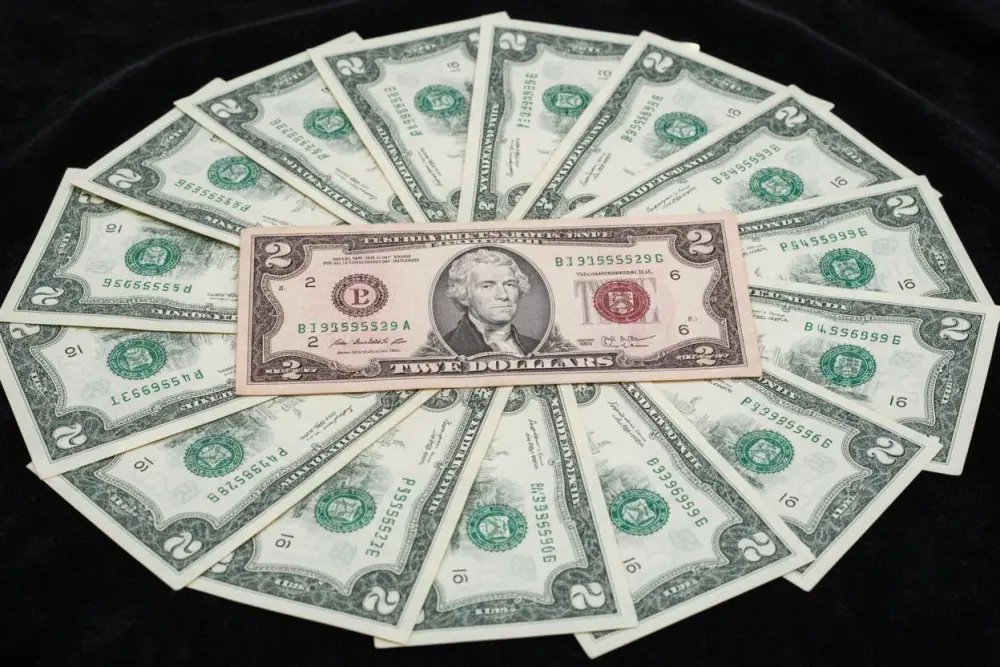
The two dollar bill is the most overestimated note in American currency. Because people rarely see them, they assume every one is valuable, but the vast majority of 1976 and later notes are worth exactly two dollars. The real premiums attach to pre-1928 large-size notes, red-seal notes from 1928 to 1963, star notes, and crisp uncirculated examples with desirable serial numbers.
What your scan returns
Point your camera at your two dollar bill and get a full report in seconds: identification, a market-based price range, condition, rarity and more. Here's an example of the kind of report you'll see.
Two Dollar Bill
1976 $2 Federal Reserve Note
$2 – $8
Condition
Crisp
Rarity
Common
Year
1976
A bicentennial-year $2 bill, crisp and uncirculated but printed in the hundreds of millions. Red-seal 1928 and 1953 notes, stars, and fancy serials carry the real premiums.
Fun fact
The $2 bill is still printed today — about 1% of US notes in circulation.
Key factors that determine Two Dollar Bill value
Series & Seal Color
Large-size notes and red-seal notes from 1928 to 1963 carry premiums. Modern green-seal 1976 and later notes are usually face value.
Condition
Crisp uncirculated notes are worth a multiple of folded, worn, or soiled examples, especially for older series.
Star Notes
A star in the serial number marks a replacement note and adds a premium, particularly on scarcer series.
Serial Numbers
Fancy serial numbers such as low numbers, solids, ladders, and repeaters attract collectors and can lift value well above face.
First-Day Novelties
1976 notes postmarked on the first day of issue exist in quantity and are generally novelties, not valuable rarities.
Tips for scanning your Two Dollar Bill
Photograph the full face flat, capturing the seal color, series date, and serial number.
Note the seal color, since red seals are older and more collectible than the common green seals.
Check the serial number for a star or a fancy pattern, both of which can add value.
Keep the note flat and uncreased. Do not laminate, tape, or trim, since any of these destroy collector value.
Two Dollar Bill market overview
The two dollar bill market is mostly a face-value market with a thin collectible layer. Common modern notes do not appreciate, despite persistent myths. The genuine premiums sit with large-size notes, red seals, star notes, and fancy serials, where condition is decisive. Certified high-grade older notes are the segment with real and durable demand.
Two Dollar Bill valuation FAQ
Are two dollar bills rare?+
No. Hundreds of millions have been printed, and the Treasury still issues them. Most 1976 and later notes are worth their two-dollar face value.
Which two dollar bills are worth money?+
Large-size notes from before 1928, red-seal notes from 1928 to 1963, star notes, fancy serial numbers, and crisp uncirculated older examples. Modern circulated notes are worth face.
Is my 1976 two dollar bill valuable?+
Almost always just two dollars, especially if it is circulated. Uncirculated examples, star notes, and fancy serial numbers are the exceptions that carry a premium.
What does a star on a two dollar bill mean?+
A star at the end of the serial number marks a replacement note printed to substitute for a misprinted one. Star notes are scarcer and carry a premium, especially on older series.
Ready to identify & value your Two Dollar Bill?
Download Value Identifier free and scan your first items, no account needed.