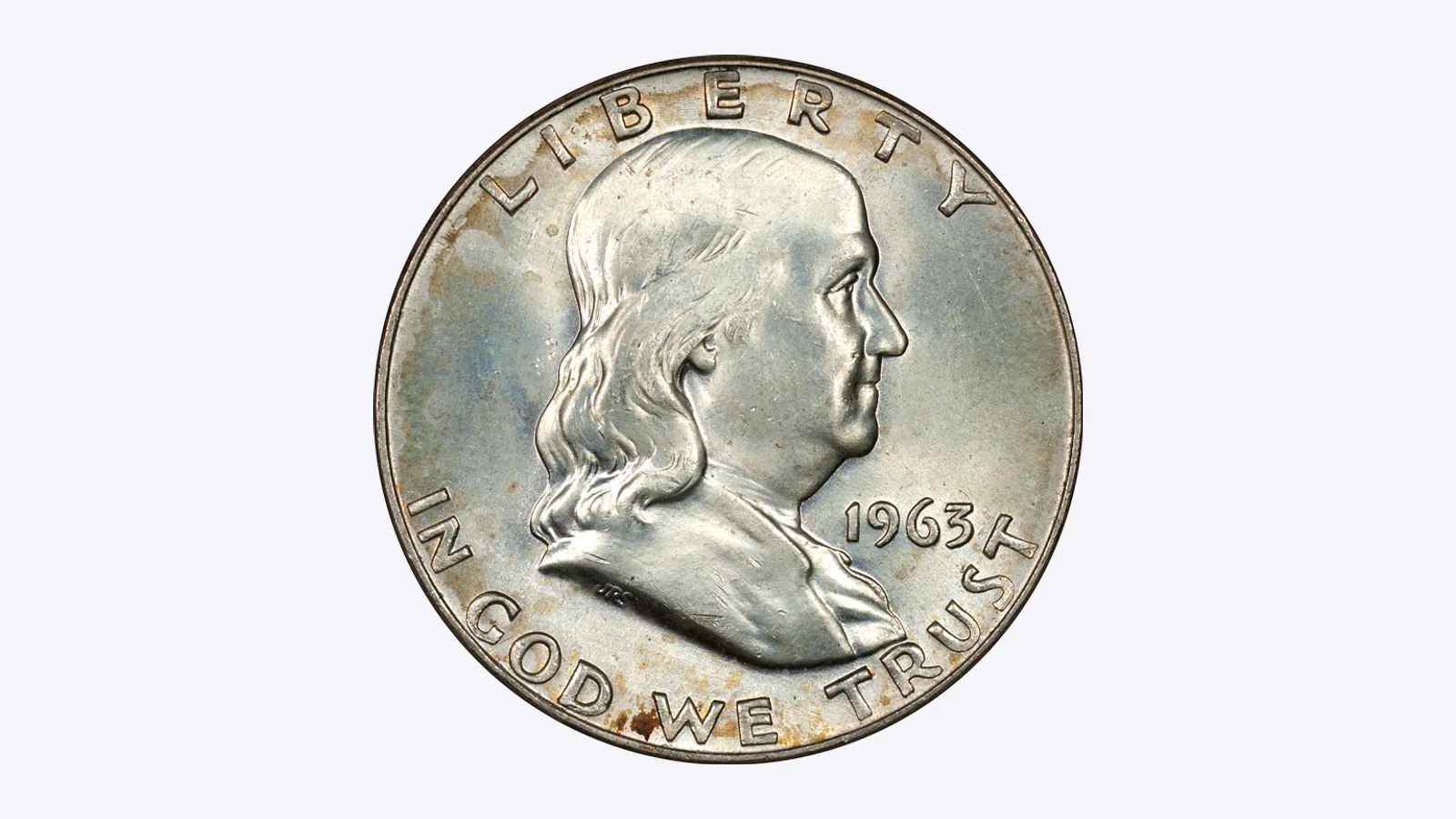
Most Franklin half dollars are worth their silver and very little more. A handful of dates, and any high grade coin with full bell lines, are worth far more. This guide sorts yours into the right bucket in four steps.
The short answer, by coin
Uncirculated ranges below are from Certified Coin Vault's Franklin half dollar guide. The record sale is from PCGS. Everything is a range because grade and strike move these coins more than anything else.
| Your coin | Typical value |
|---|
| Any date, circulated | Melt value (see step one), a little more for the low-mintage dates |
| MS63 to MS64, no full bell lines | $30 to $75 |
| MS63 to MS64, full bell lines | $50 to $200+ |
| MS65 and up, no full bell lines | $75 to $500+ |
| MS65 and up, full bell lines | $200 to several thousand |
| Scarcer dates, MS65 full bell lines | $5,000 to $15,000+ |
| 1953-S, MS65, no full bell lines | About $50 |
| 1953-S, MS65, full bell lines | Over $15,000 |
| Record: 1953-S, PCGS MS66 FBL | $69,000 (Bowers and Merena, 2001) |
Look at the two 1953-S rows. Same date, same grade, and one is worth 300 times the other. The difference is a set of horizontal lines on the Liberty Bell that most people never look at. That is the whole story of Franklin halves: the date gets you in the door, the strike decides the price.
Step one: work out the melt value
Every Franklin half, 1948 through 1963, is 90% silver and 10% copper. The coin weighs 12.50 grams and contains 0.36169 troy ounces of pure silver. That figure times today's silver spot price is the floor for any Franklin, no matter how worn.
| Silver spot price per ounce | Melt value per Franklin | Roll of 20 |
|---|
| $30 | $10.85 | $217.01 |
| $40 | $14.47 | $289.35 |
| $50 | $18.08 | $361.69 |
| $60 | $21.70 | $434.03 |
| $75 | $27.13 | $542.54 |
Check the spot price on the day you sell, multiply by 0.36169, and you have the number. Offers on circulated 90% silver are usually quoted relative to melt, so ask any buyer for their price as a percentage of melt and compare two or three. For other silver you might have in the same drawer, the gold and silver value guide covers bars, rounds and jewelry.
Step two: read the date and mint mark
The mint mark is on the reverse, above the Liberty Bell. D is Denver, S is San Francisco, and no mark means Philadelphia. Then compare against the lowest mintages in the series. Figures are business strikes, from US Mint production records as compiled on Wikipedia.
| Date and mint | Mintage |
|---|
| 1955 (Philadelphia) | 2,498,181 |
| 1953 (Philadelphia) | 2,668,120 |
| 1948 (Philadelphia) | 3,006,814 |
| 1949-S | 3,744,000 |
| 1948-D | 4,028,500 |
| 1949-D | 4,120,500 |
| 1953-S | 4,148,000 |
| 1956 (Philadelphia) | 4,701,384 |
| 1958 (Philadelphia) | 4,917,652 |
| 1954-S | 4,993,400 |
| For comparison: 1963-D | 67,069,292 |
The dates usually named as scarce are 1948, 1949-S, 1953 and 1955. Do not get excited too early. Two and a half million coins is not rare in collector terms, and a worn 1955 sells for not much more than melt. These dates carry their real premium in uncirculated grades. The 1949-S is the one most collectors call the key date, and early San Francisco coins are often weakly struck, which makes a sharp one harder to find.
Step three: the full bell lines test
Full bell lines, written FBL on a grading holder, is the designation that turns a $50 coin into a four or five figure one. The standard definition: the seven parallel lines that make up the bottom of the bell must be fully visible, and the three wisps of hair to the right of Franklin's ear on the obverse must also fully show and not blend together.
How to check it yourself:
- Use a 10x loupe and a single light source from the side. Overhead light flattens the detail you are looking for.
- Find the horizontal lines across the lower part of the bell, below the crack. Follow each line from left to right. A line that fades, merges with its neighbour or breaks in the middle fails.
- Turn the coin over and check the hair behind Franklin's ear.
- Check the bell for marks. A bag mark across the lines can cost the designation even when the strike was full.
Only bother with this on coins that look uncirculated. On a worn coin the lines are gone from wear, and the designation does not apply. If you find a coin that passes, it is worth sending to PCGS or NGC: the FBL premium only exists on a graded coin.
How rare is it at the top? PCGS reports that it has graded only 25 examples of the 1953-S in MS65 FBL, two each at MS65+ and MS66, and one at MS67, the finest it has graded for that date.
Why most Franklins fail the test
The bell lines are fine, shallow details, and on a worn die or a light strike they are the first thing to come up short. That is why the 1953-S, with over four million coins minted, has only 25 examples graded MS65 FBL at PCGS. The premium is paying for a good strike on a good day, which a mintage figure cannot tell you.
It also means you cannot shortcut the test by date. A common 1963-D with full bell lines in MS65 can be worth more than a 1955 without them. Check every uncirculated coin, not just the famous dates.
| Grade | What it looks like |
|---|
| Circulated (up to AU) | Wear on the high points: Franklin's cheek and hair, the top of the bell. Luster gone or broken in those areas. |
| MS60 to MS62 | No wear, but plenty of bag marks and dull or uneven luster. |
| MS63 to MS64 | No wear, a moderate number of small marks, decent luster. |
| MS65 and up | Few marks, none in prime areas like the face, strong unbroken luster. |
Step four: the varieties worth a second look
| What | How to spot it | What it means for value |
|---|
| 1955 "Bugs Bunny" | Die clash marks running down from Franklin's upper lip that look like two buck teeth | A fun, affordable variety. It sells for a premium over a plain 1955; check sold listings for the grade |
| Proofs, 1950 to 1963 | Mirror-like fields and frosted design, never in circulation. Mintage rose from 51,386 in 1950 to 3,218,019 in 1962 | A 1950 proof in PR65 brings over $500. Deep cameo examples from the early 1950s bring far more |
| Doubled dies and other errors | Doubling on letters or date, off-center strikes | Variety specific. See the error coin guide |
What to do with a roll or a jar of them
| Situation | Best move |
|---|
| Worn coins, any dates | Sell as 90% silver by weight or count. Work from melt, get two quotes. |
| Worn coins with 1948, 1949-S, 1953 or 1955 | Pull them out. Offer them separately; a coin dealer may pay a little over melt. |
| Coins with full luster and no wear | Do the bell lines test. Keep them out of the silver pile until you have. |
| A coin that passes the FBL test | Grade it. Without the holder the premium does not exist. |
| Proofs in original Mint sets | Keep them in the set packaging and sell as sets; collectors pay for originality. |
One rule for all of them: never clean a coin. Cleaning strips the luster that separates an uncirculated coin from a circulated one, and graders flag cleaned coins.
How Franklins compare with the other silver halves
| Half dollar | Years | Silver |
|---|
| Walking Liberty | 1916 to 1947 | 90% |
| Franklin | 1948 to 1963 | 90% |
| Kennedy | 1964 | 90% |
| Kennedy | 1965 to 1970 | 40% |
| Kennedy | 1971 onward (circulation) | None |
The Franklin replaced the Walking Liberty in 1948 and was itself replaced by the Kennedy in 1964. If your jar has all three, the Walking Liberty and 1964 Kennedy guides cover what changes for those.