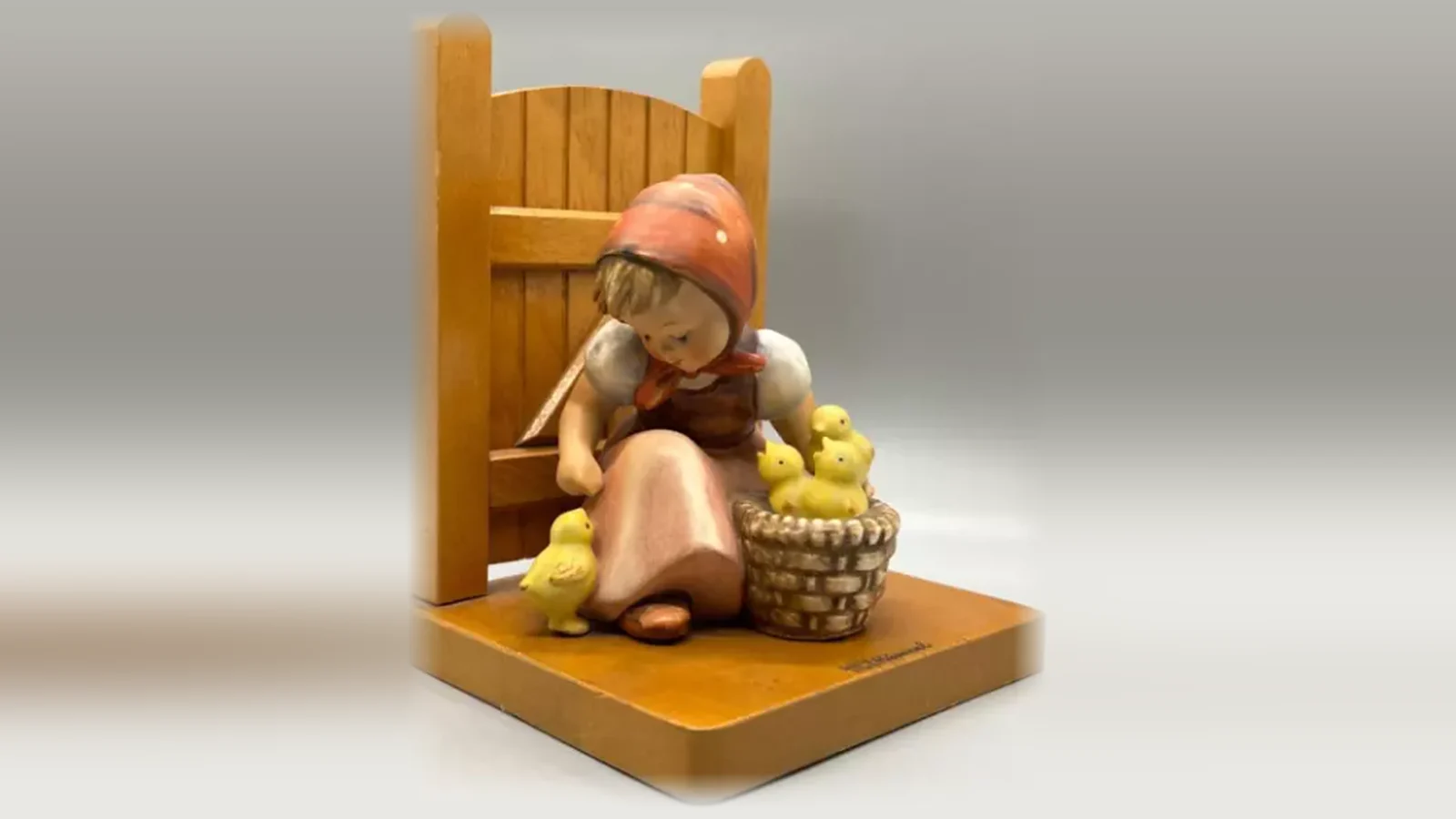
The single most important number on a Hummel is not on a price guide. It is the trademark stamped under the base, because the same figurine can be worth five to twenty times more with an early mark. Find your mark first. Everything else follows from it.
Step one: turn it over and find the mark
Every Goebel Hummel carries a trademark on the underside, and the trademark changed over the decades. Collectors number them TMK-1 to TMK-8. Here is the sequence, with the dates most collector references use, as listed in Antique Trader's trademark guide:
| Mark | Years | Name | What it looks like |
|---|
| TMK-1 | 1934 to 1950 | Crown Mark | A small crown, often with "WG" |
| TMK-2 | 1940 to 1959 | Full Bee | A bee flying inside a V |
| TMK-3 | 1958 to 1972 | Stylized Bee | A simplified, more geometric bee in the V |
| TMK-4 | 1964 to 1972 | Three Line Mark | The bee plus three lines of text |
| TMK-5 | 1972 to 1979 | Last Bee | The bee sits beside "Goebel" |
| TMK-6 | 1979 to 1991 | Missing Bee | "Goebel" with no bee |
| TMK-7 | 1991 to 1999 | Hummel Mark | Crown and "Goebel" with the Hummel name |
| TMK-8 | 2000 to 2008 | Goebel Bee | The bee returns, with "Goebel" |
The early ranges overlap because Goebel phased marks in and out, and the dates come from company records that are approximate. Some guides give narrower windows (1950 to 1955 for the full bee, 1957 to 1963 for the stylized bee). The order never changes, and the order is what moves the price.
Many pieces also carry an incised mold number (for example 141 or 347) and a size designator after a slash. Write down both: that is how auction results are listed. Some older figurines carry two marks, a crown and a full bee together, from the transition years. Collectors value those as the earlier mark.
Step two: put the mark against the price range
The Lion and Unicorn Hummel value guide gives these ranges, and the logic is simple: older marks and larger sizes are worth more.
| Tier | Typical value | Usually means |
|---|
| Common | $25 to $75 | TMK-5 through TMK-8, standard sizes |
| Mid range | $100 to $500 | Earlier marks or larger sizes |
| Valuable | $500 to $5,000+ | TMK-1 crown marks, large formats, rare designs |
The line that matters most from that guide: "A TMK-1 figurine can be worth 5 to 20 times more than the same model" made under later marks. So two figurines that look identical on a shelf can be a $40 piece and a $600 piece. The front does not tell you. The base does.
Most Hummels in family collections were bought new in the 1970s, 1980s and 1990s, which puts them in TMK-5 to TMK-7. That is why the common tier is where most figurines land.
Two practical notes on reading marks. A mark can be faint, painted over by a felt pad, or partly rubbed away; use a flashlight held at a low angle to bring up incised marks. And the size designator matters: a "/0" or "/I" after the mold number marks a different size from the same design without it, and sizes sell at different prices.
What actually sold, and for how much
These results are from Invaluable's archive of Hummel auction prices. They show both ends of the market, including the uncomfortable end.
| Item | Price | Sale |
|---|
| "Signs of Spring", mold 203, TMK-2 | $5,500 | Blackwell Auctions, January 2021 |
| "Serbian Girl", International series | $3,750 | Blackwell Auctions |
| "Swedish Girl with Letter", International series | $3,500 | Blackwell Auctions, January 2021 |
| "Hungarian Boy with Dog", International series | $3,000 | Blackwell Auctions, January 2021 |
| Jumbo "Apple Tree Boy", 30 inches | $2,500 | Blackwell Auctions, January 2021 |
| Hummel dealer's advertising plaque | $2,100 | Blackwell Auctions, January 2021 |
| Large "Adventure Bound", mold 347, TMK-5 | $600 | Blackwell Auctions, January 2021 |
| "Harmony in Four Parts", mold 471 | $150 | Hill Auction Gallery, May 2020 |
| "Apple Tree Girl and Boy", molds 141/1 and 141/2, pair | $80 | Smith Auction Company, July 2021 |
| Thirty-one Hummel plates and plaques, one lot | $50 | Gray's Auctioneers, February 2020 |
Read the bottom of that table carefully. The same Apple Tree design that sells in the thousands as a jumbo piece sold as a standard-size pair for $80. And thirty-one plates and plaques went for $50 together, under two dollars each. Size, mark and series decide everything. The International series (figurines in national costume) is a known exception that sells high.
Invaluable's own summary of the market: "modestly priced Hummels dominate the market," while exceptional examples "can sell between several hundred to several thousand dollars."
What kills the value
- Chips and repairs. A chip on a hand, hat or base edge drops a figurine sharply, and a professional restoration still has to be disclosed. Check fingertips and the brims of hats first: those break most.
- Plates and bells. Annual plates and bells were made in large numbers for collectors and sell at the bottom of the market, as the $50 lot above shows.
- Missing paperwork for limited editions. Later limited pieces came with certificates and boxes. Without them, buyers pay less.
- Selling as a lot without sorting. One TMK-1 in a box of TMK-6 figurines gets priced like the rest. Sort by mark before you sell.
Why prices are where they are
Goebel began making the figurines in 1935 from drawings by Sister Maria Innocentia Hummel. Production at the Goebel factory ended in 2008, and Manufaktur Rödental revived it briefly from 2009 to 2013, according to Lion and Unicorn. For decades they were bought as collectibles, and the generation that collected them is now downsizing. More supply plus fewer new collectors means common pieces sell for less than they cost new. The early marks, the large sizes and the scarce series are where demand is still stronger than supply.
Real Goebel or a lookalike?
The popularity of Hummels produced a lot of imitations: figurines of rosy-cheeked children in the same style, made by other companies, sold as "Hummel style" or simply unmarked. A genuine Goebel Hummel carries the incised "M.I. Hummel" signature on the base along with the trademark and the mold number. No signature, no trademark and no mold number means it is not a Goebel Hummel, however similar it looks, and it sells as a decorative figurine for a few dollars.
Price yours in ten minutes
- Read the base. Note the trademark (TMK), the mold number and any size designator after the slash.
- Check condition under good light: fingertips, hat brims, base edges. Note any chip or repair.
- Search sold listings for the figurine name plus mold number plus TMK. Ignore results with a different mark; they are a different price.
- Compare size. A larger version of the same design is a different item with a different price.
- Decide how to sell using the table below.
Hold or sell?
If you are holding common Hummels in the hope that prices recover, the evidence points the other way. The buyers who drove the market are now the sellers, and later-mark figurines exist in very large numbers in perfect condition. Waiting does not make a TMK-6 scarcer. The pieces that hold value are the ones that were already scarce: early marks, large sizes, the International series. If you own those, there is no rush. If you own a shelf of 1980s figurines and no one in the family wants them, selling now is better than selling later.
A quick decision table
| You have | Best move |
|---|
| TMK-5 to TMK-8, standard size, no damage | Sell individually online or as a sorted lot. Expect the common tier. |
| TMK-1 or TMK-2, any size | Price each piece on its own from sold listings for the same mold number and mark. |
| Large or jumbo sizes | Worth an auction house that handles figurines, especially with early marks. |
| International series figurines | Have them looked at by a specialist before you sell. |
| Plates, bells, ornaments | Sell as a lot. Do not expect more than a few dollars each. |
For other porcelain in the same cabinet, the china and porcelain guide and the Noritake china value guide cover dinnerware. For figurines from other makers, see the figurine value guide.