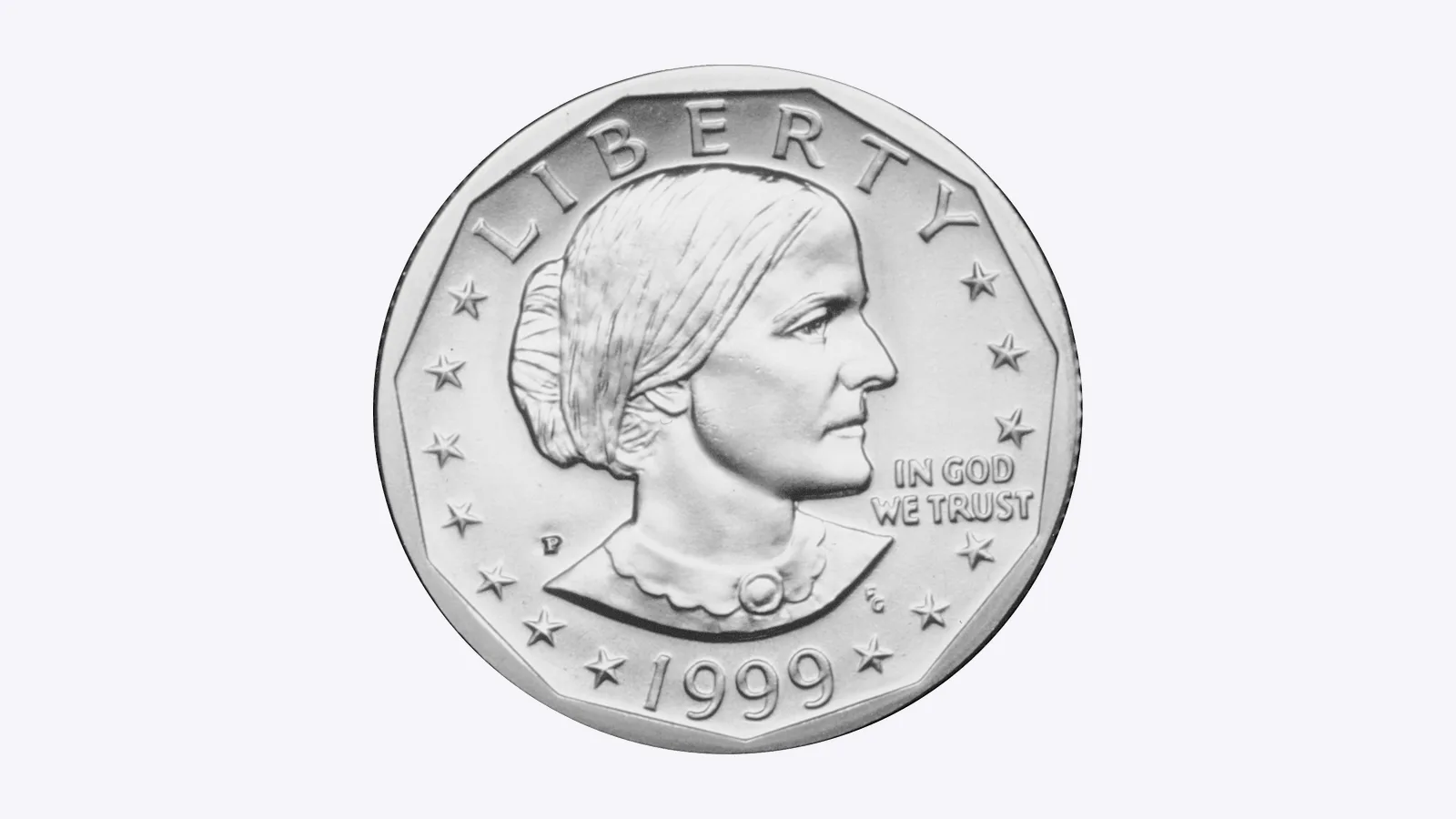
Almost every Susan B. Anthony dollar is worth one or two dollars. Four kinds are worth more, and all four can be checked in a couple of minutes with a magnifier. This guide is a checklist: run your coin through it and stop as soon as you get a no.
The answer for most coins
The Susan B. Anthony dollar was struck for circulation in 1979, 1980 and 1999, and for collectors only in 1981. Hundreds of millions were made and the public refused to use them. In 1979, according to Wikipedia's account of the coin's history, 66% of the population disliked it, mostly because it was easy to mistake for a quarter. That unpopularity is why so many survive in perfect condition, and why perfect condition alone adds almost nothing.
Coin Hub Media's value guide puts regular 1979 to 1981 strikes at $1 to $2, and 1999 coins at $3 to $5. If your coin is a normal business strike with no variety and no error, that is the answer. The rest of this page is about the exceptions.
What was made, and where
Mintage figures from US Mint records, as compiled on Wikipedia. The mint mark is on the obverse, to the left of Anthony's shoulder: P, D or S.
| Year | Philadelphia (P) | Denver (D) | San Francisco (S) | Total |
|---|
| 1979 | 360,222,000 | 288,015,744 | 109,576,000 | 757,813,744 |
| 1980 | 27,610,000 | 41,628,708 | 20,422,000 | 89,660,708 |
| 1981 | Collector sets only | Collector sets only | Collector sets only | 9,742,000 |
| 1999 | 29,592,000 | 11,776,000 | None | 41,368,000 |
The 1981 coins are the lowest mintage, but they were sold to collectors in sets, so most of them were saved in new condition. Low mintage plus high survival equals a cheap coin. The 1999 issue exists because Congress had already authorized the Sacagawea dollar and the Mint could not start it fast enough, so it struck Anthonys for one more year as a stopgap.
Question one: is it actually a Susan B. Anthony dollar?
People mix these up with quarters and with Sacagawea dollars all the time. Three quick checks:
| Coin | Color | Shape of the inner border | Portrait |
|---|
| Susan B. Anthony dollar | Silver colored | Eleven-sided inner border inside a round edge | Woman facing right, 13 stars around |
| Washington quarter | Silver colored | Plain round border | Man facing left |
| Sacagawea or Native American dollar | Golden | Plain round border, smooth edge | Woman with a baby on her back |
The eleven-sided border is the giveaway, as Coin Hub Media's guide points out. If yours is golden, you have a Sacagawea: see the Sacagawea dollar value guide instead.
Question two: is it a 1979-P with the date near the rim?
This is the one variety on regular circulation coins that pays. Wikipedia describes it as a 1979 Philadelphia strike "on which the date appears nearer to the rim," and notes it "commands a higher price than the regular issue." Collectors call it the wide rim or near date.
How to check: put your 1979-P next to any other Anthony dollar from 1979 or 1980 and compare the gap between the bottom of the date and the rim. On the normal coin there is visible space. On the wide rim the date nearly touches it, and the rim itself looks broader. Only P coins from 1979 qualify. A D or S cannot be one.
Coin Hub Media lists the 1979-P wide rim at $150 to $200 and the near date at $50 to $100, which reflects how loosely sellers use the two names for the same variety. Treat $50 to $200 as the range, with grade deciding where yours lands.
Question three: is it a proof with a clear S?
Proofs have mirror-like fields and frosted portraits and were sold in Mint proof sets, all with an S mint mark. In 1979 and 1981, the Mint changed the punch it used to put the S on the dies partway through the year. Wikipedia: these coins bear a mint mark "applied to the coinage dies with a different punch, causing them to have a more legible appearance. They are considered scarce and are valued considerably higher than normal proofs."
Collectors call the early, blobby S Type 1 and the clear, sharply defined S Type 2. Under a loupe, a Type 1 S looks filled in and rounded, a Type 2 S has open loops and crisp serifs. Prices from Coin Hub Media:
| Proof | Typical value |
|---|
| 1979-S Type 1 (filled S) | $15 to $25 |
| 1979-S Type 2 (clear S) | $50 to $100 |
| 1981-S Type 1 | $10 to $20 |
| 1981-S Type 2 | $250 to $400 |
The 1981-S Type 2 is the one to look for. It came late in the year, so far fewer were made, and it is the most valuable Anthony a normal person is likely to own. If you have a 1981 proof set still in its original Mint packaging, check it before you sell it as a set.
Question four: is there an error?
Errors are the last category, and the only one where an Anthony dollar gets into four figures. Coin Hub Media lists an Anthony dollar struck on a quarter planchet at $1,000 and up, for any date. A coin struck on the wrong planchet is smaller and thinner than it should be and often shows part of the design missing off the edge.
Other error types (off-center strikes, clipped planchets, doubled letters) exist on Anthony dollars too, and their value depends on how dramatic the error is. The error coin guide covers how to tell a real mint error from damage that happened after the coin left the Mint. Damage is worth nothing; graders reject it.
If every answer was no
| What you have | What to do |
|---|
| Circulated 1979, 1980 or 1999 coins | Spend them. They are legal tender and any bank takes them at face. |
| Uncirculated rolls or bags of common dates | Sell as a lot for a small premium, or spend them. Do not pay to grade them. |
| Mint sets and proof sets | Check the 1979 and 1981 proofs for the Type 2 S first, then sell as sets. |
| A 1979-P you are not sure about | Compare it next to another Anthony, then check sold listings for "1979-P wide rim" in the same grade. |
Selling one that passed
If your coin cleared one of the four questions, the next steps are the same whichever it was.
- Do not clean it. Cleaning leaves hairline scratches that graders flag, and a cleaned proof loses the mirror finish that makes it a proof.
- Price it from sold listings, not asking prices. Search the exact name ("1981-S Type 2 proof", "1979-P wide rim") and filter by sold. Asking prices on varieties run well above what buyers actually pay.
- Grade only the ones that justify it. A 1981-S Type 2 or a wide rim in high grade is worth sending to PCGS or NGC, because buyers pay more for a variety confirmed on the holder. A 1979-S Type 1 proof worth $15 to $25 is not.
- Keep proof sets intact until you have checked them. The Type 2 S is visible through the original packaging with a loupe, so check without opening it. Selling an unchecked set can give a Type 2 away at set price.
How it fits with the other small dollars
The Anthony replaced the large Eisenhower dollar, which was too big for most people to carry, and was itself replaced by the golden Sacagawea in 2000. None of the three is silver in circulation form. If you have a jar of mixed old coins, the coin value guide is the place to sort them by type before you check any one series in detail.