What Is Your Eisenhower Dollar Worth?
Try it free, identify any item
Snap or upload a photo and get its value in seconds
The Eisenhower dollar ran from 1971 to 1978 and came in two flavors: copper-nickel clad coins made for circulation and 40% silver coins sold to collectors. They look almost identical, which is exactly why people misjudge them. Value Identifier helps tell them apart and estimates the value.


Why knowing your Eisenhower Dollar value matters
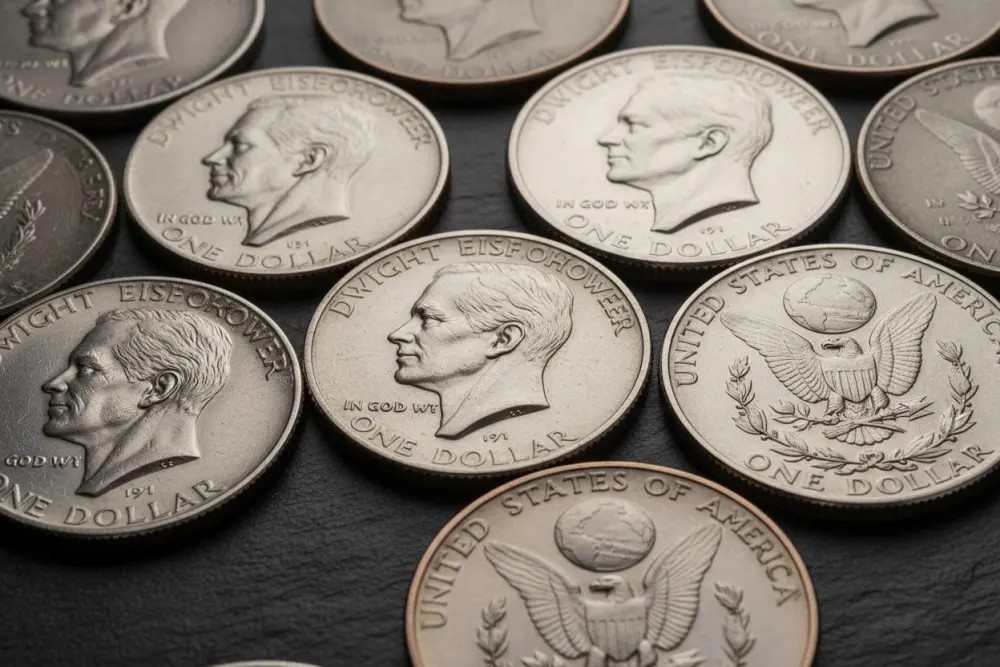
Most Eisenhower dollars are clad and worth little more than a dollar, so owners hoping for a windfall are usually disappointed. The value lives in the 40% silver versions from special mint and proof sets, in high-grade examples, and in a few varieties. Confusing a common clad coin for the silver issue is the most frequent mistake with this series.
What your scan returns
Point your camera at your eisenhower dollar and get a full report in seconds: identification, a market-based price range, condition, rarity and more. Here's an example of the kind of report you'll see.
Eisenhower Dollar
1972 Eisenhower Dollar
$2 – $5
Condition
Circulated
Rarity
Clad Common
Year
1972
A circulated clad Ike dollar worth a small premium over face. The 40% silver 'Blue Ike' and 'Brown Ike' collector versions are where these get interesting.
Fun fact
The Ike dollar reverse celebrates Apollo 11 — an eagle landing on the Moon.
Key factors that determine Eisenhower Dollar value
Composition: Clad vs Silver
Circulation coins are copper-nickel clad and common. The 40% silver coins from blue packs and brown boxes carry a real premium.
Condition
Ike dollars are large and mark easily. High-grade, mark-free examples are scarcer than the huge mintages suggest.
Proof vs Business Strike
Proof and silver proof issues are worth more than circulated business strikes and were never meant for spending.
Varieties
Reverse die varieties, especially on 1972 Philadelphia coins, are collected and can add value.
Bicentennial Type
The 1976 dual-date Bicentennial reverse comes in clad and 40% silver, with the silver version carrying the premium.
Tips for scanning your Eisenhower Dollar
Photograph the full coin on both sides, since the AI uses color, edge, and surface cues to gauge clad versus silver.
Capture the mint mark above the date on the obverse, since S issues are where silver coins live.
Shoot the surfaces under even light to reveal contact marks that affect grade on these large coins.
Handle by the edges. Fingerprints on a high-grade Ike dollar are difficult to remove and hurt value.
Eisenhower Dollar market overview
The Eisenhower market is modest for circulated clad coins, which are abundant and cheap. The action is in 40% silver issues, top-grade certified examples, and recognized varieties, where a dedicated collector base supports steady prices. The series is affordable to assemble, which keeps new collectors coming in.
Eisenhower Dollar valuation FAQ
How do I know if my Eisenhower dollar is silver?+
The 40% silver coins were sold in blue packs for uncirculated and brown boxes for proof, and carry an S mint mark. Clad coins show a copper edge. Value Identifier weighs the visual cues to estimate which you have.
Are Eisenhower dollars worth anything?+
Common clad coins are worth a little over a dollar. The 40% silver versions, proofs, high grades, and certain varieties are where the meaningful value is.
What is the Bicentennial Eisenhower dollar?+
The 1975 to 1976 coins carry the dual date 1776-1976 and a Liberty Bell and moon reverse. They exist in common clad and premium 40% silver versions.
Why is my Eisenhower dollar so big?+
It was the last large-size circulating dollar, at 38mm and over 22 grams. The size made it unpopular for daily use, which is why so many survive in collections.
Ready to identify & value your Eisenhower Dollar?
Download Value Identifier free and scan your first items, no account needed.