What Is Your Buffalo Nickel Worth?
Try it free, identify any item
Snap or upload a photo and get its value in seconds
The Buffalo nickel, struck from 1913 to 1938, is one of the most admired American designs. Its weak point is the date, which wore off quickly in circulation. Value Identifier reads what detail remains to identify the coin and estimate its grade and value.


Why knowing your Buffalo Nickel value matters
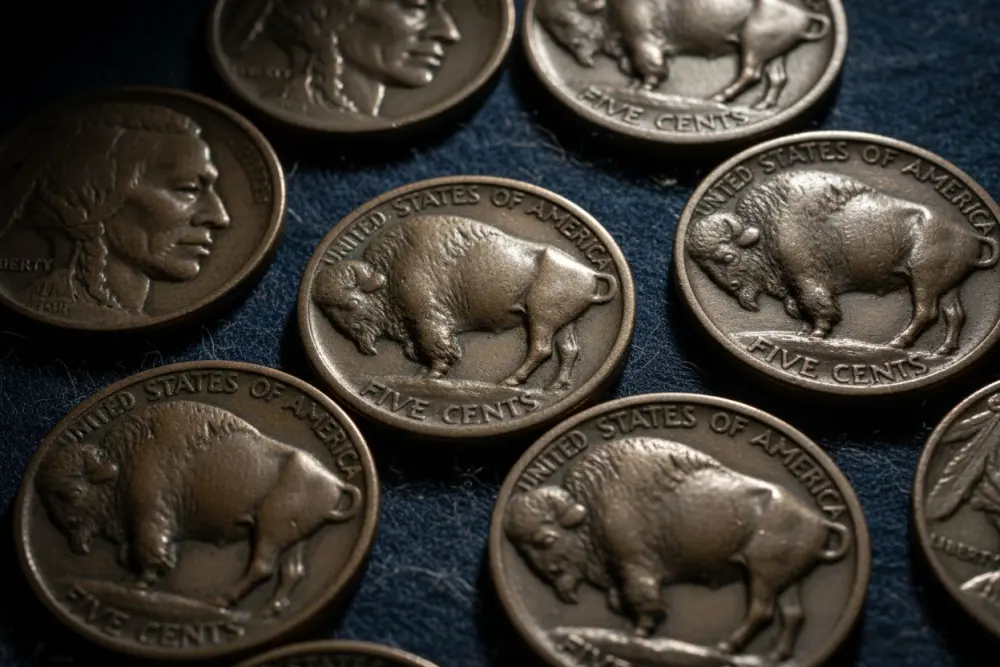
Buffalo nickels are everywhere in old collections, and most are dateless, which makes them nearly worthless beyond a few cents. The ones that matter have a readable date and a key mint mark, or a famous error. The difference between a dateless common coin and a sharp 1913-S Type 2 is the difference between bulk and serious money.
What your scan returns
Point your camera at your buffalo nickel and get a full report in seconds: identification, a market-based price range, condition, rarity and more. Here's an example of the kind of report you'll see.
Buffalo Nickel
1936 Buffalo Nickel
$1 – $4
Condition
Very Fine
Rarity
Common Date
Year
1936
A well-struck late-date Buffalo with full horn detail visible. Dateless buffalos are worth face value; the 1937-D three-legged variety is the famous error worth hundreds.
Fun fact
The buffalo on the coin was modeled on Black Diamond, a bison at the Central Park Zoo.
Key factors that determine Buffalo Nickel value
Date & Mint Mark
Keys include 1913-S Type 2, 1921-S, 1924-S, and 1926-S. The mint mark sits under FIVE CENTS on the reverse.
Date Visibility
A fully readable date is essential. Dateless Buffalo nickels are worth only their small base value.
Errors & Varieties
The 1937-D three-legged buffalo and the 1918/7-D overdate are the marquee varieties and carry large premiums.
Condition
A sharp horn and full detail on the buffalo, plus a clean cheek and braid on the obverse, separate average coins from premium ones.
Surfaces
Original surfaces matter. Acid-restored dates, a common trick to revive a worn date, are detectable and carry no collector premium.
Tips for scanning your Buffalo Nickel
Photograph the obverse to capture whatever remains of the date on the raised area below the profile.
Shoot the reverse to read the mint mark beneath FIVE CENTS and to judge the buffalo's horn and detail.
Use raking light from a low angle to bring out faint date digits on worn coins.
Do not apply acid or restoration products. Restored dates are obvious to buyers and kill the premium.
Buffalo Nickel market overview
The series splits hard between dateless bulk coins and collectible dated examples. Key dates and the famous errors have strong, durable demand. High-grade common dates with full strikes are popular with type collectors. Acid-dated and heavily worn coins are abundant and cheap, so condition honesty drives the real prices.
Buffalo Nickel valuation FAQ
Why doesn't my Buffalo nickel have a date?+
The date sat on a high point of the design and wore off in circulation. Dateless Buffalo nickels are common and worth only a few cents each.
What is the rare three-legged Buffalo nickel?+
The 1937-D three-legged variety, caused by an over-polished die, removed one of the buffalo's front legs. It is a well-known error that commands strong premiums in any grade.
Where is the mint mark on a Buffalo nickel?+
On the reverse, below the words FIVE CENTS. No mark means Philadelphia, D is Denver, and S is San Francisco.
Are Buffalo nickels silver?+
No. They are 75% copper and 25% nickel, with no silver content. Their value is numismatic, not bullion.
Ready to identify & value your Buffalo Nickel?
Download Value Identifier free and scan your first items, no account needed.