Scan Any Quarter and See What It's Worth
Try it free, identify any item
Snap or upload a photo and get its value in seconds
Quarters span silver Washington issues, the 50 State Quarters, America the Beautiful designs, and a long list of errors and varieties. A small fraction are worth far more than twenty-five cents. Value Identifier reads the date, mint mark, and design to flag the ones worth a second look.


Is your quarter worth more than 25 cents?
Put in the date and mint mark. Almost every answer is no, and the tool says so plainly rather than stringing you along — but it knows the handful of dates, varieties and errors that are the exception.
On 1932–1964 quarters the mint mark is on the back, under the wreath below “QUARTER DOLLAR”. From 1968 it moved to the front, to the right of Washington's ponytail. Philadelphia coins before 1980 have no mark at all.
Melt value moves with spot, so put today's number in rather than trusting a figure baked into a web page months ago.
The 30-second sort
- 1. Date 1964 or earlier? Pull it. It is silver. No exceptions, no further thought.
- 2. 2019 or 2020? Check for a W next to the ponytail.
- 3. Tilt it to the light and look for raised metal that should not be there.
- 4. Everything else is twenty-five cents. Spend it.
1964 D
90% silver
$6.15 melt, minimum
Every quarter dated 1964 or earlier is 90% silver — 0.1808 troy ounces of it. That sets a hard floor under the coin no matter how worn it is, and it is why the standing advice is to pull every pre-1965 quarter without even looking at the date closely. A collectable date or a high grade is worth more than melt, never less.
Can't find the mint mark?
It is a single small letter and on a worn coin it is genuinely hard to see. Photograph both sides and the AI reads the date, mint mark and design for you.
Scan my quarterThe quarters actually worth pulling
This is the whole list for circulating coins. Everything else is silver content or an error, and the two 1932 dates are the only classic key dates in the Washington series.
| Coin | Mintage | Worth |
|---|---|---|
| 1932-D Washington | 436,800 struck | $100 – $3,500+ |
| 1932-S Washington | 408,000 struck | $80 – $2,000+ |
| 2019-W America the Beautiful | 2 million per design | $10 – $20 |
| 2020-W America the Beautiful | 2 million per design | $10 – $20 |
Varieties hiding in modern quarters
These are ordinary coins with a specific flaw. The date alone means nothing — you need the flaw itself, which is why each row says what to look at.
| Coin | What to look for | Worth |
|---|---|---|
| 1999-P Delaware "Spitting Horse" | A die crack runs from the horse's mouth, so it looks like it is spitting. | $20 – $500+ |
| 2004-D Wisconsin Extra Leaf (high and low) | An extra leaf on the corn, either high or low. An MS-66 example took $12,000 at auction. | $50 – $1,000+ |
| 2005-P Minnesota "Extra Tree" doubled die | Doubling in the treeline gives an extra small tree. Values climb steeply above MS-65. | $100 – $600 |
| 2020-P American Samoa "Faceless Bat" | A filled die leaves the fruit bat with no facial detail. | $50 – $500 |
Telling a real error from a lookalike
One rule covers most of it: anything that came from the die is raised above the surface, and anything that happened to the coin afterwards is sunken into it. A 10x loupe is enough — you do not need a microscope.
| Error | The tell | Mistaken for |
|---|---|---|
| Doubled die | Crisp, clearly separated doubling on letters or numbers. | Machine doubling, which looks blurry or shelf-like and is worth essentially nothing. This is the single most common false alarm. |
| Die chip | A raised blob of metal where no design belongs. | Post-mint damage. A die chip is always raised above the field; damage is sunken or scratched. |
| Die crack | A raised, irregular line wandering across the surface. | A scratch. Same rule as above: raised means it came from the die, sunken means it happened afterwards. |
| Off-centre strike | The design sits off to one side with blank planchet showing. | Nothing much — this one is unambiguous and always worth pulling aside. |
Mintages from US Mint figures. Values compiled from 2026 pricing published by CoinValueChecker, Gainesville Coins, FindBullionPrices, L&C Coins and Heritage Auctions results. Retail ranges spanning worn to high grade. Last reviewed August 2026.
Why knowing your Rare Quarters value matters
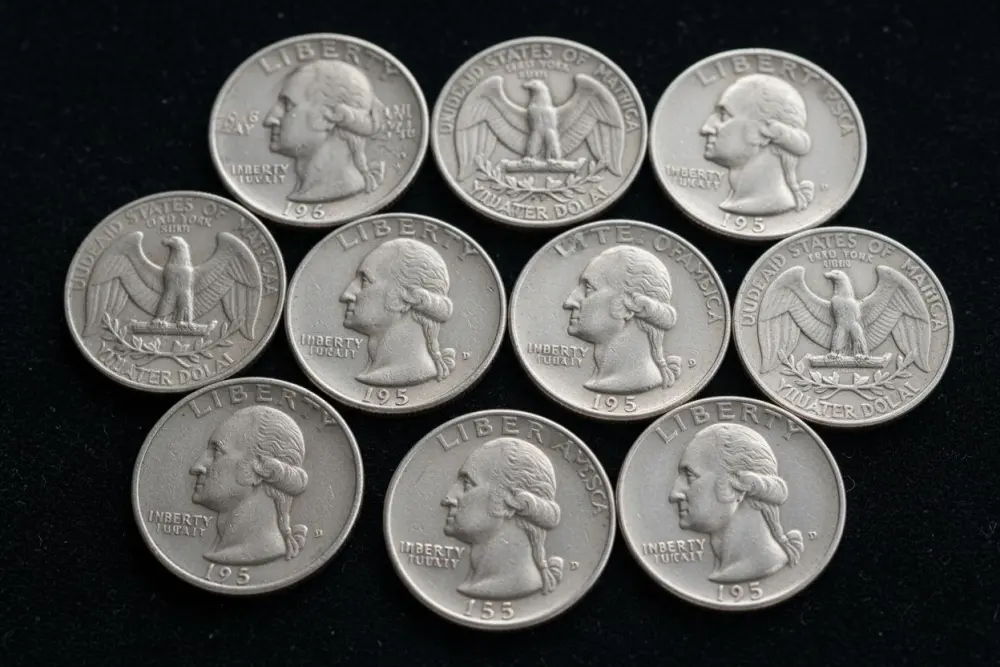
Quarters are the coin people search most for hidden value, partly because of online error hype. Most circulating quarters are worth face, but pre-1965 silver coins, certain state quarter errors, and high-grade examples are genuinely valuable. Sorting the real from the imagined is the whole point, and it comes down to a few checkable details.
What your scan returns
Point your camera at your rare quarters and get a full report in seconds: identification, a market-based price range, condition, rarity and more. Here's an example of the kind of report you'll see.
Rare Quarters
1932-D Washington Quarter
$150 – $400
Condition
Fine
Rarity
Key Date
Year
1932
The king of Washington quarters with the low-mintage Denver mint mark. First-year keys like this hold value in any grade — even heavily worn examples bring three figures.
Fun fact
Only 436,800 quarters were struck in Denver in 1932, versus hundreds of millions in later years.
Key factors that determine Rare Quarters value
Silver: Pre-1965
Washington quarters dated 1964 and earlier are 90% silver and worth several times face for metal alone.
Key Dates
Early Washington dates like 1932-D and 1932-S are the classic keys and carry strong premiums.
State Quarter Errors
Varieties such as the 2004 Wisconsin extra leaf and various off-center and die errors are the modern coins that bring premiums.
Condition
For modern coins, only very high certified grades move the needle. Worn examples stay at face.
Proof & Silver Proof
Proof issues, especially silver proofs from collector sets, are worth more than circulation coins.
Tips for scanning your Rare Quarters
Photograph the obverse with the date and mint mark visible to check for silver years and key dates.
Shoot the reverse design, which identifies state and America the Beautiful issues where errors live.
Photograph any suspected error clearly and in focus, since the error itself is what carries the value.
Check the date for pre-1965 silver first. It is the most common real value people overlook.
Rare Quarters market overview
The quarter market is bottom-heavy with common coins worth face and topped by a thin band of silver, key dates, errors, and high grades that sustain real demand. The silver floor on pre-1965 coins is the most reliable value. Modern error premiums are real but specific, and most viral error claims do not hold up.
Rare Quarters valuation FAQ
Which quarters are worth the most money?+
Pre-1965 silver quarters for their metal, early key dates like 1932-D and 1932-S, certain state quarter errors, and high-grade certified coins. Value Identifier flags which group yours falls into.
How do I know if my quarter is silver?+
Check the date. Quarters from 1964 and earlier are 90% silver. A silver coin also lacks the copper-colored stripe visible on the edge of clad coins.
Are state quarter errors really valuable?+
Some are. The 2004 Wisconsin extra leaf and genuine off-center or doubled-die errors carry premiums. Ordinary state quarters from circulation are worth face.
Is my quarter rare just because it is old?+
Not necessarily. Age helps mainly when combined with silver content, a key date, or high grade. Many older quarters are still worth only their silver or face value.
Ready to identify & value your Rare Quarters?
Download Value Identifier free and scan your first items, no account needed.