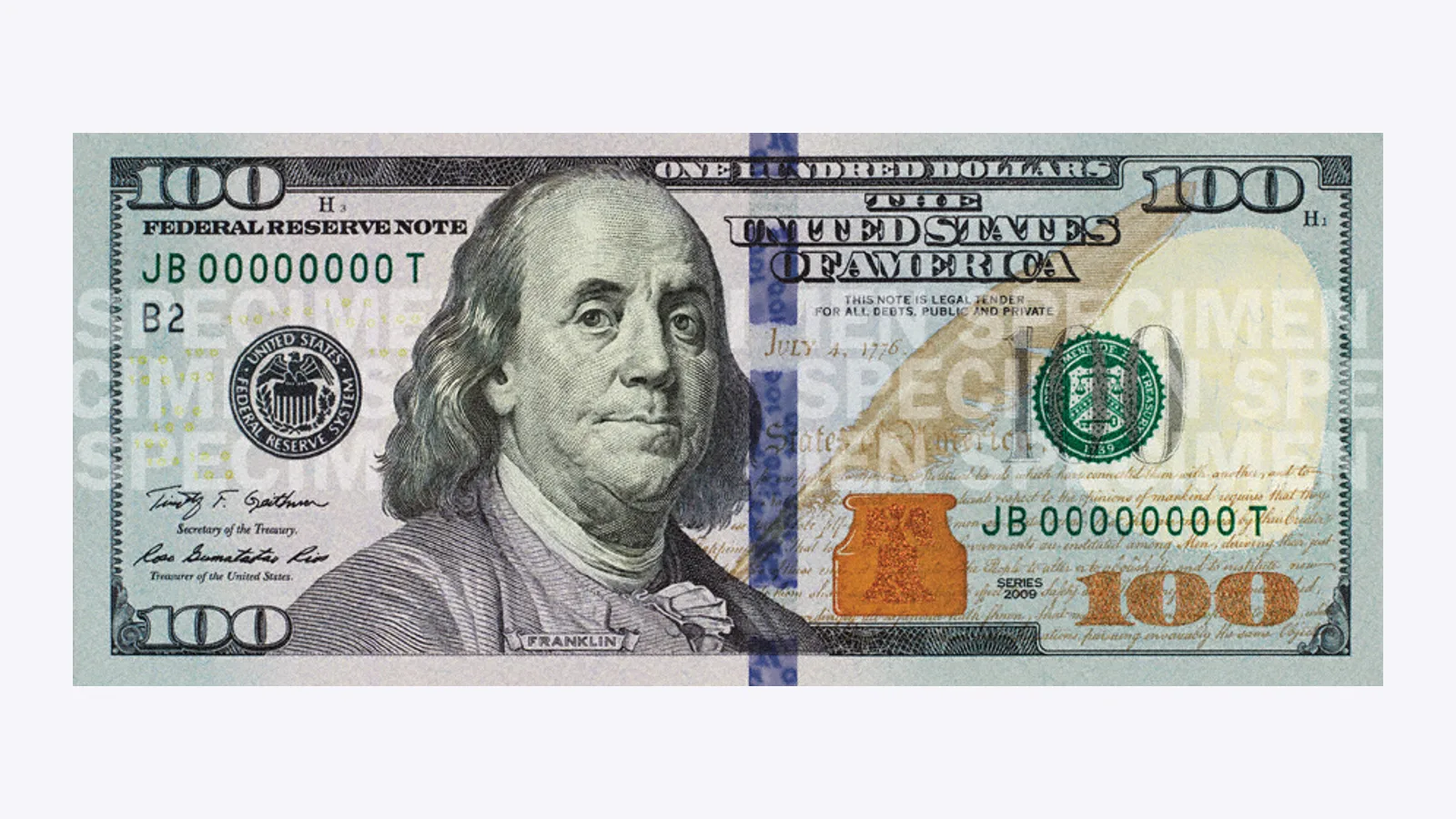
Every type and what it sells for
Definitions and price ranges below are from MyCurrencyCollection's guide to fancy serial number types and values, which tracks notes that actually sold. Ranges are for ordinary modern Federal Reserve Notes. Radar prices come from The Penny Hoarder, because MyCurrencyCollection does not give one.
| Type | Rule | Example | Typical price |
|---|---|---|---|
| Solid | Every digit the same | 88888888 | $1,000 to $4,000 |
| Ladder | Each digit one higher or lower than the last | 12345678 | $900 to $1,900 |
| Low serial, single digit | Seven zeros then one digit | 00000007 | $500 to $1,000 |
| High serial, 9999999X | Seven nines up front | 99999995 | $500+ |
| Low serial, 000000XX | Six zeros up front | 00000042 | $100 to $300 |
| High serial, 999999XX | Six nines up front | 99999931 | $100 to $300 |
| Super repeater | First two digits repeated four times | 39393939 | $100 to $300 |
| Partial ladder | A ladder with a break or doubled digits | 00112233 | About $100 |
| Seven in a row | Seven identical digits together | 77777771 | $50 to $150 |
| True binary | Only zeros and ones | 10011010 | $40 to $150 |
| Low serial, 00000XXX | Five zeros up front | 00000512 | $30 to $75 |
| High serial, 99999XXX | Five nines up front | 99999412 | $50 to $75 |
| Binary | Only two different digits | 74774774 | $20 to $75 |
| Repeater | First four digits equal the last four | 74627462 | $25 to $50 |
| Radar | Reads the same backwards | 12533521 | About $25, sometimes $100+ |
| Low serial, 0000XXXX | Four zeros up front | 00003318 | Sometimes slightly over face |
Three types have no reliable price at all: trinary (only three different digits), quad double (55553333) and birthday serials (07041776). They sell, but to one buyer at a time, so any number you see quoted is one sale, not a market.
The top of the range is far higher than the table suggests. The Penny Hoarder reports a $100 bill with a solid 8 serial that sold for $19,200, and puts a 00000001 note at up to $15,000. Those are outliers: high denomination, perfect pattern, top condition.
The odds, worked out
Prices follow scarcity, and for serial patterns scarcity is plain arithmetic. An eight-digit serial has 100,000,000 possible values in each letter block. Count how many of those fit a pattern and you get the odds of pulling one from a random note. This table is math, not a price source.
| Pattern | How many per 100,000,000 | Odds per note |
|---|---|---|
| Ladder (strict, up or down) | 6 | 1 in 16.7 million |
| Solid (11111111 to 99999999) | 9 | 1 in 11.1 million |
| Super repeater (not solid) | 90 | 1 in 1.1 million |
| Quad double | 90 | 1 in 1.1 million |
| Seven in a row (not solid) | 180 | 1 in 556,000 |
| True binary (not solid) | 254 | 1 in 394,000 |
| Low serial, 00000001 to 00000999 | 999 | 1 in 100,000 |
| Radar | 10,000 | 1 in 10,000 |
| Repeater | 10,000 | 1 in 10,000 |
| Binary (exactly two digits) | 11,430 | 1 in 8,750 |
The two tables line up. Radars and repeaters are each 1 in 10,000, which sounds rare until you count how many bills pass through a single cash register in a year. That is why they trade for tens of dollars. Solids and strict ladders are one in many millions, and they are the only patterns that reliably clear $1,000.
One caveat on high serials. MyCurrencyCollection notes that modern notes printed on 32 and 50 note sheets only run to 96,000,000, so 9999XXXX serials do not exist on those notes at all. A high serial worth chasing comes from older series.
What the odds mean if you search bills yourself: radars, repeaters and binaries together make up roughly 3 in every 10,000 serials, allowing for overlap. A single strap of 100 notes will usually hold nothing. Search a few hundred straps, around 30,000 notes, and you can expect to find about nine of them. Solids and ladders are not something you find by searching. They come from buying them.