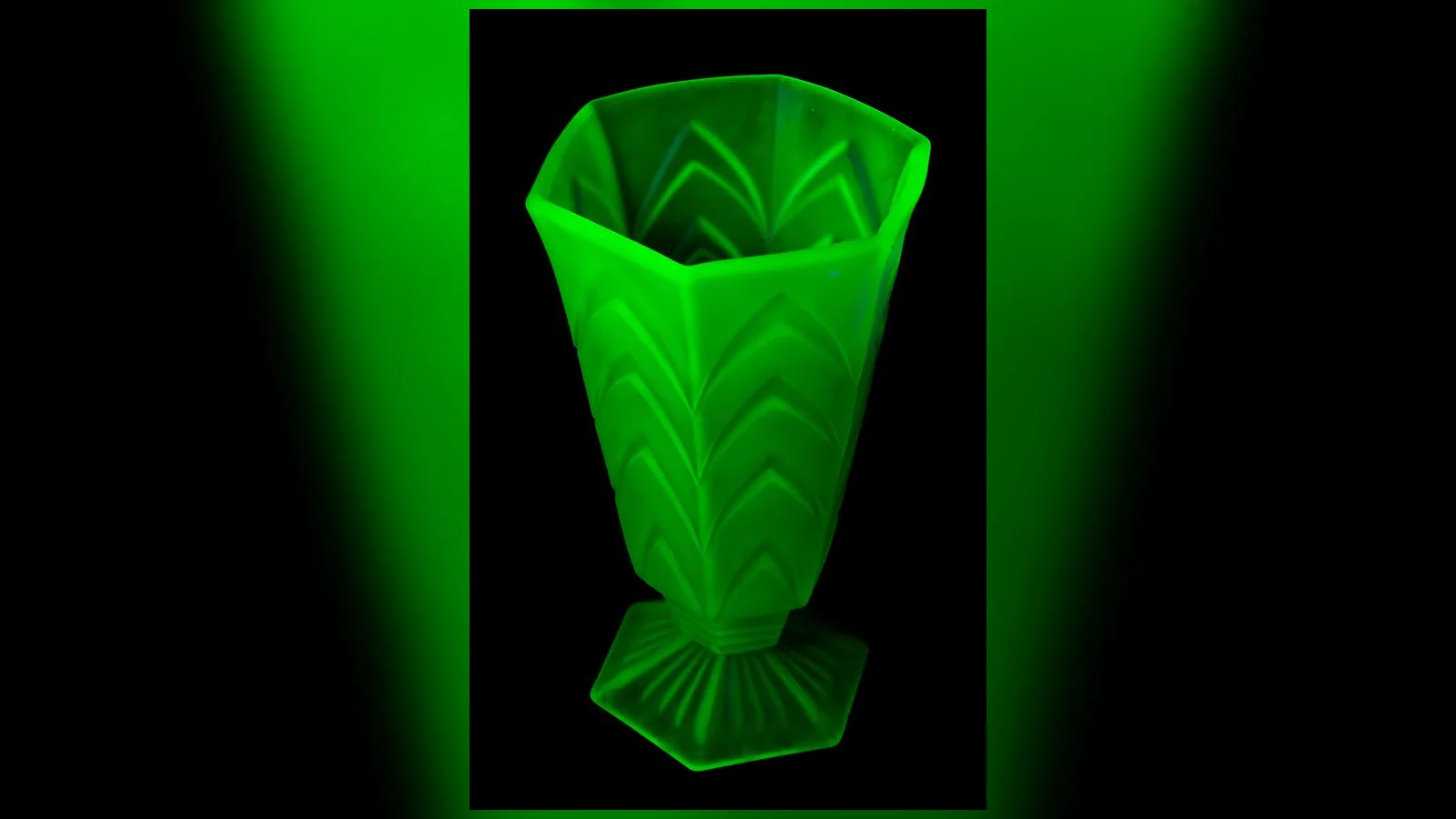
Depression glass was given away in cereal boxes and sold for pennies. Most of it still sells for little. A few patterns in the right color sell for hundreds, and one footed casserole went for $3,250. The difference comes down to color first, pattern second, and whether the piece is original at all.
What it is, in one paragraph
Depression glass is machine-made clear or colored glassware produced from 1929 to 1939 in the United States and Canada, according to Wikipedia. Food companies like Quaker Oats put a piece in boxes as an incentive to buy, and movie theaters handed it out to patrons. More than twenty manufacturers, most of them in the Ohio River Valley, made more than 100 patterns. It has been collected since the 1960s.
So there is a lot of it. That fact explains every price below.
Color first
Two guides agree on the order. Estimonia's depression glass price guide puts cobalt blue at the top, then ruby red, with green and amber at the bottom. Wikipedia lists the common colors as clear, pink, pale blue, green and amber, and the less common ones as yellow, ultramarine, jadeite, delphite, cobalt blue, red, black, amethyst, monax and white.
| Color | How common | What it means for value |
|---|
| Cobalt blue | Less common | Highest premium |
| Ruby red | Less common | Strong premium |
| Pink | Common, but heavily collected | Steady demand, pattern dependent |
| Green | Common | Moderate to low |
| Amber and clear | Very common | Lowest; most pieces sell for a few dollars |
| Delphite, jadeite, ultramarine | Less common | Specialty interest; price by piece |
Estimonia puts common pieces at $5 to $35 each. That is where most of a typical box of depression glass lands.
Then pattern
Pattern turns a color into a price. These are the sales Estimonia reports for the patterns collectors chase most:
| Piece | Price |
|---|
| Pink Mayfair (Open Rose) footed casserole, excellent condition | $3,250 (2022 sale) |
| Set of six blue Mayfair footed tumblers, pristine | Just under $720 |
| Cobalt blue Royal Lace covered butter dish | $689 (2023 sale) |
| Cobalt Royal Lace, other pieces | $200 to $700 |
| Pink Mayfair cookie jar | $200 to $300 |
| Common pieces, most patterns | $5 to $35 |
Notice what sells: Mayfair and Royal Lace, in cobalt, blue and pink, in serving forms like butter dishes, cookie jars and casseroles. A plain amber saucer in a common pattern is not on this list and never will be.
Form matters as much as pattern. Within the same pattern and color, a cookie jar, butter dish, covered casserole or pitcher is worth many times a plate or saucer, because households received far more plates than serving pieces, and lids broke. If you have a lidded piece with its original lid in a collected color, that is the item to research first.
Identify the pattern
Depression glass is priced by pattern, so naming the pattern is the step that unlocks a real price. These are the patterns that come up most in price guides, with the maker usually credited for each:
| Pattern | Maker | What to look for |
|---|
| Royal Lace | Hazel-Atlas | A lace-like border of scrolls and flowers |
| Mayfair (Open Rose) | Anchor Hocking | Open rose blossoms and a scalloped edge |
| Cameo (Ballerina) | Anchor Hocking | A small dancing figure inside the design |
| Cherry Blossom | Jeannette | Cherries and branches |
| American Sweetheart | Macbeth-Evans | Scrolls and swags, often in pink or monax white |
To identify yours, describe the motif in a search ("depression glass pink rose pattern") and compare images until the shape and border match exactly. Pay attention to the edge and the center: many patterns share flowers but differ in the border. Then search sold listings for the pattern name, color and piece type together.
Is it original? The reproduction checks
Wikipedia is direct about the problem: popular and expensive patterns have been reproduced, and reproductions are still being made. The valuable pieces above are exactly the ones that get copied. Run these checks, from Estimonia's guide, before you price anything in a top pattern:
- Weight. Genuine depression glass is thin and lightweight. Reproductions tend to be heavier.
- Detail. Originals have softer pattern detail from worn production molds. Overly sharp, crisp detail is a warning sign.
- Seams and bubbles. Look for faint vertical mold seams and tiny bubbles in the glass. Both are normal in the originals.
- The base. Originals typically have no polished pontil and no maker's mark on the base.
- Compare. Put the piece next to a known original of the same pattern, or a clear photo of one, and compare shape and color side by side.
A reproduction is worth what any modern glass dish is worth. If a cobalt Royal Lace piece looks too new, it probably is.
Why some of it glows
Some depression glass is uranium glass, which fluoresces under ultraviolet light, as Wikipedia notes. Under a small UV flashlight, uranium glass glows bright green. Collectors use the glow to sort pieces and some collect glowing glass for its own sake. A glow does not mean a piece is depression glass, since uranium was used in other glassware too, and it does not add value on its own. It is one more clue, not a verdict.
UV flashlights are cheap and worth having if you sort a lot of old glass.
Condition
| Problem | What it does |
|---|
| Chips on rims, lids or feet | Cuts value sharply. Run a fingertip around every edge. |
| Cloudiness ("sick glass") | Usually from dishwashers. It does not wash off and lowers value. |
| Scratches in the center of plates | Normal wear; lowers the price of plates and platters. |
| Missing lids | A cookie jar or butter dish without its lid loses most of its value. |
Why it was cheap then and collected now
The glass was made to be inexpensive: machine pressed, quickly produced, given away as a premium. Wikipedia describes its original quality as marginal. What made it collectible from the 1960s on was nostalgia, color and the fact that complete patterns are hard to assemble decades later. That history explains the shape of the market today. Common colors and pieces were produced in such quantities that they remain cheap. The pieces that sell high are the ones that were scarce from the start: unusual colors, serving forms that fewer households received, and patterns made for a short time. When you sort a box, you are looking for scarcity, not age, because everything in the box is the same age.
Where to sell it
| Option | Good for | Watch out for |
|---|
| Online marketplaces, by the piece | Named patterns in collected colors | Glass breaks in shipping; pack each piece in its own box |
| Glass shows and collector clubs | Rare pieces and full sets in top patterns | You need to know the pattern names |
| Antique malls and consignment | Mixed boxes of common pieces | Commission and slow turnover |
| Local listings, as a lot | Amber, clear and common green | Buyers expect low prices |
What to do with a box of it
| You have | Best move |
|---|
| Amber, clear and common green pieces | Sell as a lot or use them. Expect $5 to $35 a piece at most. |
| Pink pieces in a named pattern | Identify the pattern and check sold listings piece by piece. |
| Cobalt, ruby or blue Mayfair, Royal Lace serving pieces | Run the reproduction checks, then price individually from sold listings. |
| Anything with chips or cloudiness | Sell for use, not as a collectible. |
For the iridescent glass that often shares the same shelf, see the carnival glass value guide. For cut crystal and other glassware, start with the crystal and glassware guide, and for kitchen glass from the same era, the vintage Pyrex guide.