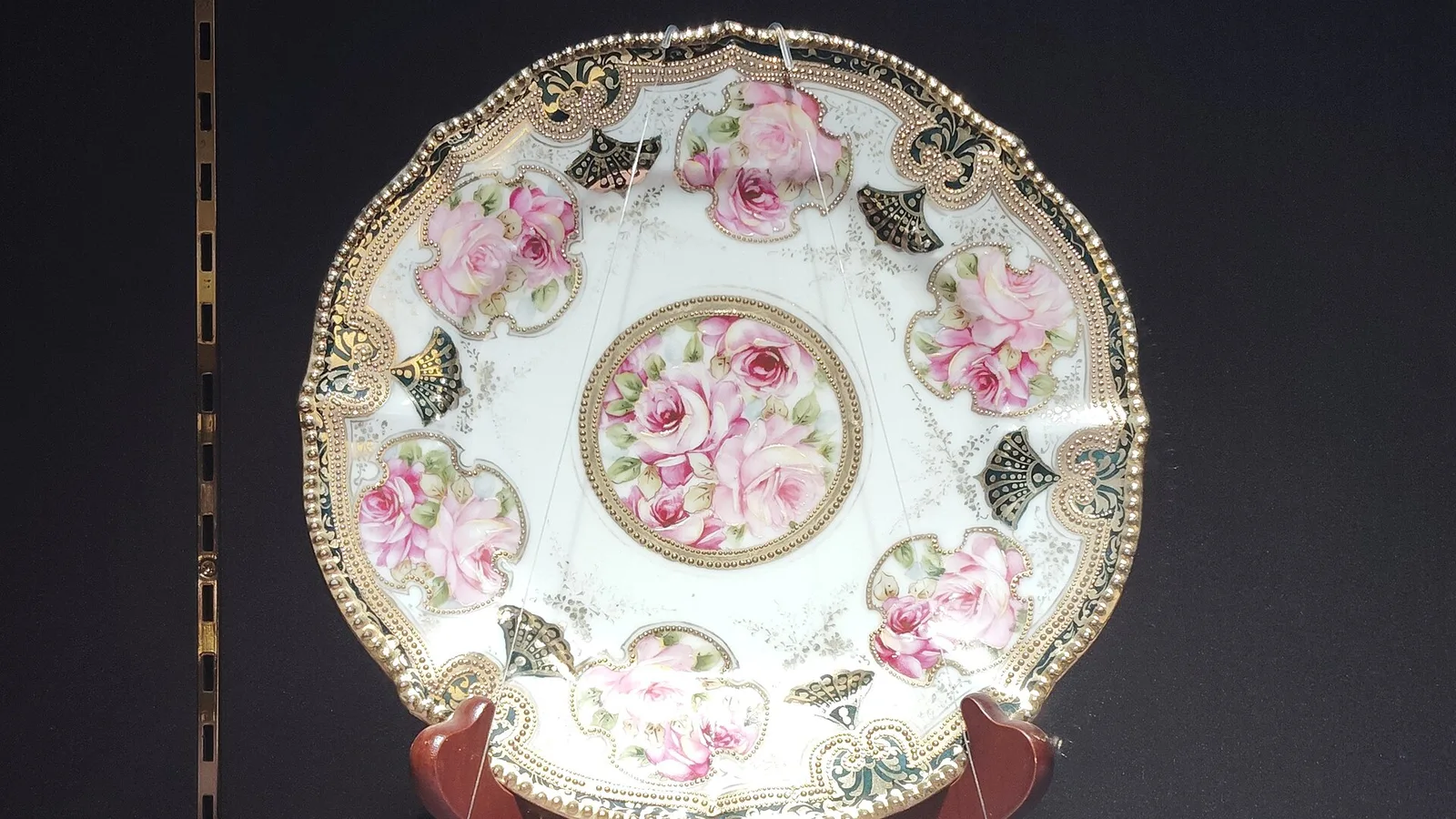
Most Noritake dinnerware is worth less than people hope and more than nothing. The price depends on three things you can check at the kitchen table: how old the backstamp says it is, which pattern it is, and whether you sell it as a set or by the piece.
Question one: how old is it?
Turn a plate over. The backstamp dates the piece, and age is the first sorting step. These dating rules are from Invaluable's guide to Noritake china:
| Backstamp says | Approximate date | Why |
|---|
| "Nippon" | Before 1921 | US import rules required the country of origin, and Japan was marked as Nippon |
| "M" inside a wreath | 1911 through World War II | The M stands for Morimura, the founding family |
| "Japan" or "Made in Japan" | 1921 onward | The required country name changed |
| "Occupied Japan" or "Made in Occupied Japan" | Around 1948 to 1952 | Postwar occupation period |
| A pattern name and number | Mostly postwar dinnerware | Used to identify and reorder patterns |
A little history explains the marks. Ichizaemon Morimura and his brother Toyo opened Morimura Brothers in New York City in 1876. The family founded the factory Nippon Toki Kaisha in 1904 and produced its first Western-style dinner set, called Sedan, in 1914. That is why the earliest Noritake for the US market carries Nippon and Morimura marks.
Question two: which pattern is it?
Postwar Noritake sets usually carry a pattern name and a number on the back. Write down both. That pair is the only reliable way to price a set, because Noritake made thousands of patterns and prices are set pattern by pattern. Replacements, Ltd. lists discontinued china patterns and is a practical place to match a pattern name to a picture.
Two older patterns come up constantly:
| Pattern | What it looks like | What Invaluable reports |
|---|
| Azalea | Pink flowers on white with gold trim, made between 1915 and 1930 | One of the most collected early patterns |
| Tree in the Meadow | A painted landscape with a tree and a cottage | Many antique examples sell for around $20; rarer items can reach the hundreds |
Tree in the Meadow is a useful reality check. It is old, hand painted, and widely collected, and most pieces still sell for about $20. Age alone does not make Noritake valuable.
Early hand painted Noritake from the Nippon era is a separate market from postwar dinnerware. Vases, bowls and decorative plates with raised gold, moriage (raised slip decoration) or detailed painted scenes are collected as decorative art and priced one by one. If your piece has a Nippon or M in wreath mark and heavy hand decoration, research it individually instead of with the dinner set.
Question three: set or pieces?
This is where most people lose money in one direction or the other.
- A full set in a common postwar pattern is hard to sell as a set, because few buyers want 12 place settings. It often sells for less than the same pieces would bring one at a time to people replacing a broken plate.
- Serving pieces (platters, covered vegetable dishes, gravy boats, teapots) are what pattern collectors are missing most often. Sold separately, they can carry a set's value.
- Early Nippon era and hand painted pieces sell as individual decorative items, not dinnerware. A single vase or bowl is priced on its own.
Before you list anything, search sold listings for the exact pattern name and number, piece by piece. If a few dinner plates sell for a few dollars each and nobody buys sets, you have your answer.
The exceptions that sell high
Invaluable's guide gives two examples at the top of the market:
| Item | Price |
|---|
| Frank Lloyd Wright Imperial Hotel dinnerware set | $13,000 |
| A second Frank Lloyd Wright Imperial Hotel set | $5,000 |
| Lusterware punch bowl set | $260 |
The Imperial Hotel dinnerware is a design object first and china second: buyers are paying for Frank Lloyd Wright. It does not tell you anything about a family set from the 1960s. The lusterware punch bowl is the more realistic marker for an attractive decorative piece.
Condition rules for china
| Problem | Effect on value |
|---|
| Worn or faded gold trim | Common on pieces that went through a dishwasher. Lowers value noticeably on gold rimmed patterns. |
| Chips and cracks | Most buyers replacing pieces will not take a chipped plate at all. |
| Crazing (fine cracks in the glaze) | Reduces value, and is a reason buyers avoid using pieces for food. |
| Utensil marks (gray scratches) | Visible on the plate surface; lowers price on dinner plates. |
Hold each piece under a strong light and run a fingertip around the rim before you price it. Describe faults honestly; buyers of replacement china return anything that does not match the description.
Why full sets disappoint
People expect a complete set to be worth more than its parts, because it cost more than its parts when it was bought. The resale market works the other way. Most buyers of Noritake are not furnishing a new dining room; they are replacing the two plates and one gravy boat that broke in their own set. A set of twelve place settings has one buyer in a hundred, while a single platter in the same pattern has many. That is why pieces sell more reliably than sets, and why serving pieces carry so much of the value.
The other reason is weight and fragility. Shipping a full set is expensive and risky, which limits buyers to people within driving distance. A single plate ships anywhere.
If nobody in the family wants the set and the sold prices are low, using it every day is a perfectly good outcome. It was made to be used.
Research your pattern in ten minutes
- Photograph the backstamp of a dinner plate in sharp focus. The pattern name and number are often small.
- Search the pattern name and number together. This brings up pictures so you can confirm the match, and replacement dealers who list the pattern.
- Count what you have by piece type: dinner plates, salad plates, cups, saucers, bowls, serving pieces. Buyers ask for counts.
- Check sold listings for the same pattern, by piece type. Note the price of a single dinner plate and of each serving piece.
- Add it up both ways: pieces sold individually versus the set as one lot. Pick the larger, then weigh it against the time it takes to ship china safely.
Where to sell it
| Option | Good for | Watch out for |
|---|
| Replacement china dealers | Patterns they actively stock | They pay well below their retail price |
| Online marketplaces, by the piece | Serving pieces and popular patterns | Packing and shipping china takes time and breaks happen |
| Local listings, as a set | Complete sets, no shipping | Few buyers want a full set; expect a low offer |
| Estate sale or consignment shop | Selling everything at once | Commission and slow sales |
| Auction house | Nippon era hand painted pieces, design pieces | Ordinary dinnerware is usually not accepted |
What to do with a Noritake set
| You have | Best move |
|---|
| Postwar set with a pattern name and number | Check sold prices piece by piece. Sell serving pieces separately; sell plates in small groups. |
| Nippon or M in wreath pieces | Price individually as antiques. Photograph the mark clearly in the listing. |
| Occupied Japan pieces | Small decorative pieces are collected for the mark; price from sold listings. |
| Gold trim worn, chips, crazing | Sell as a lot for use, or donate. |
For other dinnerware and porcelain makers, see the china and porcelain value guide. If the cabinet also holds figurines, the Hummel figurine guide covers how to date and price them, and the silverware guide covers the flatware drawer.