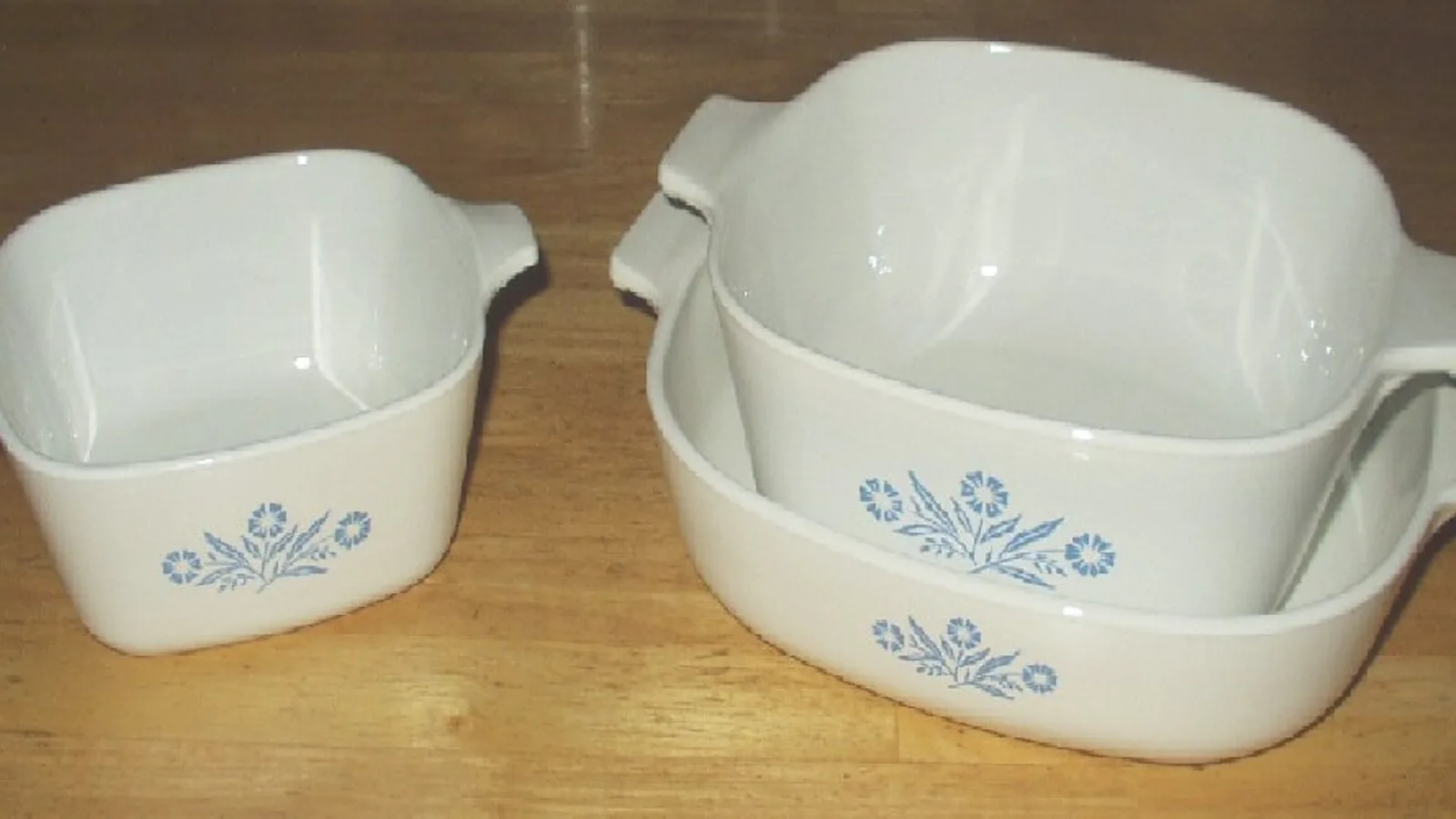
Vintage CorningWare is worth something, just not what the viral listings say. A Blue Cornflower casserole usually sells for tens of dollars, not thousands. What decides the price is the material, the backstamp, the pattern and whether the lid is there. Here is how to check each one.
First: is it the real thing?
CorningWare was introduced in 1958 by Corning Glass Works, according to Wikipedia. It was made from Pyroceram, a glass-ceramic that S. Donald Stookey discovered by accident in 1953 when a furnace malfunction turned photosensitive glass into a milky white material that survived extreme temperature changes. That material is what collectors want.
The brand changed hands over the years. World Kitchen, the later owner, discontinued US production in 2001 and introduced a stoneware bakeware line under the same name. Pyroceram CorningWare came back in December 2008 as CorningWare StoveTop, made in France.
| Check | Original Pyroceram | Later stoneware |
|---|
| Era | 1958 to the late 1980s for most collector pieces | 2001 onward |
| Weight and walls | Thin walled, glass-ceramic | Thicker and heavier |
| Stovetop use | Yes, it could go on a burner | Marked as not for stovetop use |
| Collector interest | The main focus | Generally less collectible |
If the bottom says it is not for stovetop use, you have the stoneware version. It is a useful dish and a weak collectible.
One more quick check: Pyroceram has a smooth, slightly glassy feel and rings when tapped lightly with a fingernail, while stoneware feels more like regular pottery. Combined with the stovetop marking and the weight, that settles it in seconds.
A short timeline
| Year | What happened |
|---|
| 1953 | S. Donald Stookey discovers the glass-ceramic later called Pyroceram |
| 1958 | CorningWare launches; the first pattern, Wheat, underperforms; Blue Cornflower follows |
| 2001 | World Kitchen ends US production and introduces stoneware bakeware under the name |
| 2008 | Pyroceram returns in December as CorningWare StoveTop, made in France |
All dates from Wikipedia. The collector window is the long stretch between 1958 and the switch to stoneware.
CorningWare, Pyrex and Corelle are not the same thing
| Brand | What it is | Typical pieces |
|---|
| CorningWare | White glass-ceramic (Pyroceram) cookware | Casseroles, saucepans, skillets, percolators |
| Pyrex | Glass bakeware, often with colored patterns on opaque glass | Mixing bowls, refrigerator dishes, casseroles |
| Corelle | Thin, layered glass dinnerware | Plates, bowls, mugs |
People mix them up constantly, partly because CorningWare casseroles often came with clear glass lids. Each has its own collector market and its own price guides, so price each by its own name.
Second: read the backstamp
Pyroceram pieces carry a model code on the base. Appraisily's guide to old CorningWare notes that early "P-series" pieces, made from 1958 to 1972, command a premium over "A-series" pieces from 1972 to 1988. The code also shows the capacity, which tells you exactly which lid fits.
Write down the code before you price anything. Searching sold listings for "P-1-B" or "A-2-B" with the pattern name gives far better comparisons than "old CorningWare dish".
Third: the pattern
Blue Cornflower is the pattern most people own. Wikipedia credits it to designer Joseph Baum and notes it became the trademark of Corning consumer products for three decades, after the first pattern, Wheat, did not sell well in 1958. Other patterns collectors recognize include Floral Bouquet, Spice O' Life, French White and Shadow Iris, along with less common ones like Country Festival.
What Blue Cornflower actually sells for: Hunker reports that authentic pre-owned Blue Cornflower casserole dishes typically hover in the $30 to $45 range, with some climbing into the hundreds. That is the honest middle of the market. Less common patterns and unusual shapes (percolators, teapots, specialty pieces) sell above it; plain casseroles in the most common patterns sit at or below it.
Why the viral listings are wrong
Every few months a story circulates about CorningWare listed for thousands of dollars. Those are asking prices. Anyone can list a casserole for $5,000; the question is whether it sold. Filter by sold listings and the same pattern and size usually lands in the range above. Price from what buyers paid, never from what sellers hope.
The same goes for "rare pattern" claims in listing titles. A pattern is rare if few were made, not because a seller says so. If the sold results for a pattern show dozens of sales at low prices, it is not rare, whatever the listing says.
Fourth: condition and lids
Appraisily's guide is blunt on both: chips roughly halve the value, and missing original lids knock the value down. Mismatched lids hurt too.
| Problem | What it does |
|---|
| Missing lid | A casserole without its matching lid sells for noticeably less |
| Wrong or mismatched lid | Lowers the price; buyers want the lid that matches the model code |
| Chips on the rim or handles | Roughly halves the value |
| Faded or scratched pattern | Lowers value; dishwasher wear shows on the cornflower decoration |
| Gray utensil marks | Often clean off; worth trying a gentle cleaner before you photograph |
Listing it so it sells
- Put the model code in the title. Collectors search for "P-1-B" and similar codes, and the code tells them which lid fits.
- Photograph the base and the lid separately. Buyers want to see the backstamp, and the lid's own markings, to confirm it matches.
- Show the rim close up. Chips are the first thing buyers look for; showing a clean rim avoids questions and returns.
- Say whether it has been used on the stovetop. Burn marks on the base are common on pieces that were used, and buyers prefer to know.
- Clean it first. Gray marks from metal utensils often come off with a gentle cleaner, and a clean piece photographs and sells better.
- Group small pieces. Petite pans and small casseroles sell better as sets of three or four than one at a time.
What sells above the average
Appraisily's guide points to the pieces that carry a premium: less common patterns such as Country Festival, specialty forms like the Sauce Maker and the Menu-ette, and percolators and teapots. The logic is the same as with any collectible. Casseroles were made by the millions; a percolator in a less common pattern was not. If your cupboard holds something other than a standard round or square casserole, research it on its own before selling it in a lot.
Complete sets in original boxes are the other exception. A boxed set with its paperwork tells a buyer the pieces were barely used, and boxed sets are scarce because most people threw the boxes away.
Keep using it or sell it?
Original Pyroceram CorningWare could go from freezer to oven to stovetop, which is exactly why people still cook with it decades later. If your pieces are common patterns worth tens of dollars, the honest answer is that they may be worth more to you in the kitchen than at a sale. Sell the scarce shapes and patterns, and keep or give away the everyday casseroles.
What to do with your CorningWare
| You have | Best move |
|---|
| Blue Cornflower casseroles with lids | Sell individually or in a small set; expect tens of dollars each. |
| P-series pieces in good condition | Mention the P code in the listing; early pieces carry a premium. |
| Less common patterns or shapes | Price each from sold listings for the exact pattern and piece. |
| Stoneware pieces from 2001 onward | Use them, donate them, or sell cheaply as kitchenware. |
| Chipped pieces or no lids | Sell as a lot for use. |
If the same cupboard holds glass bakeware, the vintage Pyrex value guide covers patterns and prices, and the cast iron skillet guide covers the pans. For glass from an older generation, see the depression glass value guide.