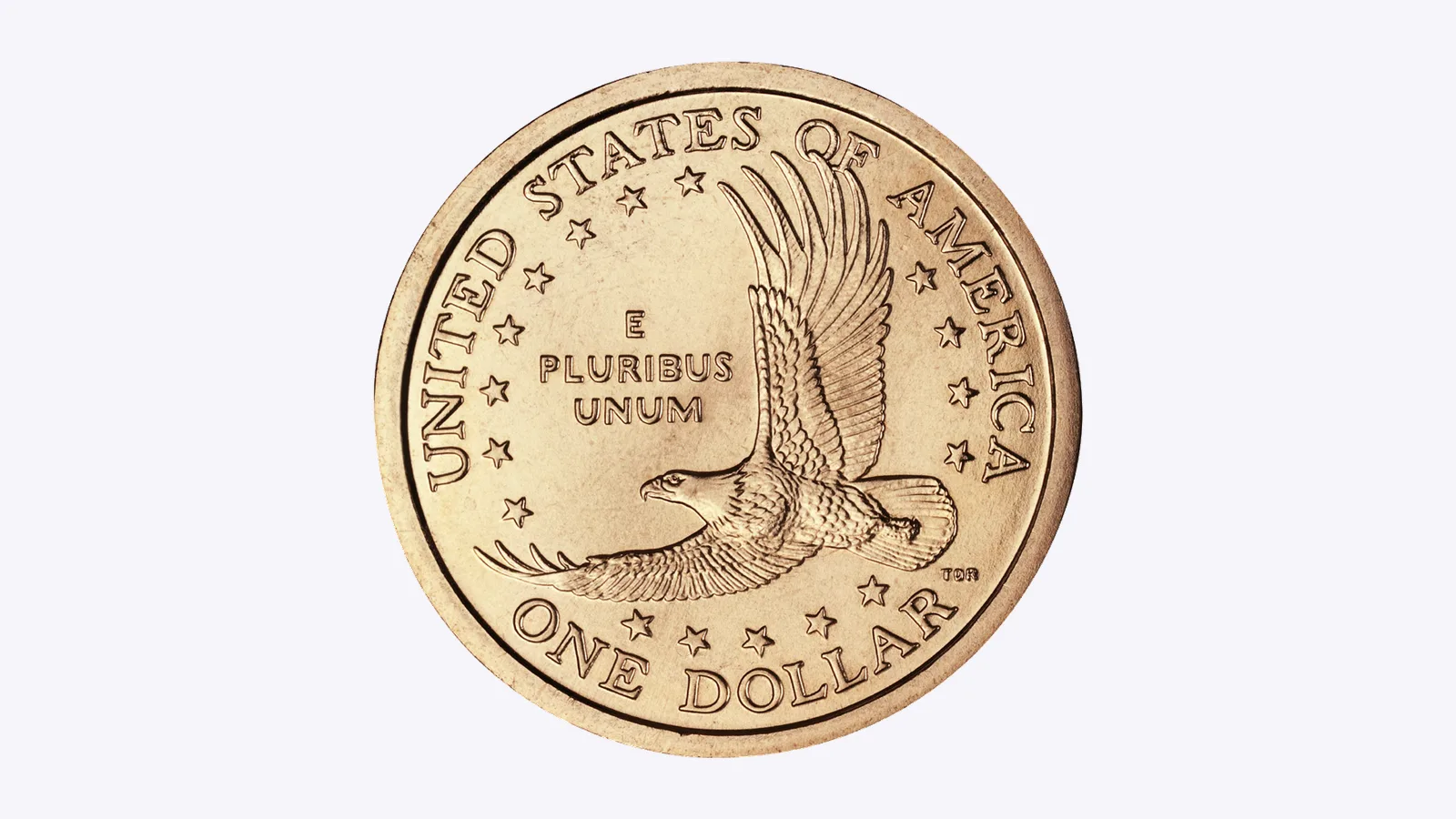
The golden dollar collects more myths than any modern US coin. It is not gold, a 2000-P is not rare, and the famous rarities cannot be spotted from across the room. Here is each myth, the fact behind it, and what the coins that matter actually sell for.
Myth 1: it is made of gold
It contains no gold at all. The Sacagawea dollar has a pure copper core clad in manganese brass: 77% copper, 12% zinc, 7% manganese and 4% nickel, according to the specifications listed on Wikipedia. It weighs 8.1 grams and measures 26.49 mm. The color comes from the manganese brass and it tarnishes to brown with handling, which is why worn ones look nothing like new ones.
If your coin is golden, round, with a smooth edge and a woman carrying a baby on her back, it is a Sacagawea. For real gold coins, which are a completely different market, see the gold coin value guide.
Myth 2: a 2000-P is rare
The opposite. 2000 was the coin's first year and the Mint made enormous numbers. Mintages from Wikipedia:
| Year and mint | Mintage | What it means |
|---|
| 2000-P | 767,150,500 | The most common Sacagawea there is |
| 2000-D | 518,916,000 | Also extremely common |
| 2001-P | 62,468,000 | Common |
| 2001-D | 70,939,500 | Common |
| 2002 onward | Struck for collectors, not circulation (2002 total: 10,809,605) | Lower mintage, but sold in rolls and sets and saved new |
A circulated Sacagawea of any date is worth one dollar. The guide at USStateQuarters.com puts an ordinary uncirculated MS65 at $3 to $12. The coins that sell for real money are specific varieties and errors, not dates.
Myth 3: any 2000-P with a nice eagle is a Cheerios dollar
In early 2000 the Mint and General Mills put new dollars in boxes of Cheerios as a promotion. Wikipedia counts about 5,500 coins in cereal boxes. Some of them were struck from an early die with more detailed tail feathers on the eagle, and those are the Cheerios dollars collectors pay for. Not every coin from the promotion has the feathers, and not every coin with sharp feathers came from Cheerios.
The difference is in the tail: the enhanced version has raised, distinct parallel lines on the central tail feathers, where the regular coin has smoother, flatter feathers. You need a loupe and a known regular coin to compare. USStateQuarters.com reports only 60 to 70 verified examples and prices for certified coins of $4,000 to $33,000, with high grade specimens selling between $11,500 and $33,000.
Myth 4: the mule is a legend
It is real, and it is the most valuable modern US coin error. In 2000 a few Sacagawea reverses were struck with the obverse of a Washington state quarter, producing a coin that is golden, dollar sized, and has George Washington on the front. Wikipedia counts eleven authenticated examples at the time of its writing and reports one collector paying as high as $75,000 for a single specimen, with sale prices reaching $200,000. USStateQuarters.com puts the known count higher, at 18, and the price range at $96,000 to $204,000.
The counts differ by source, which tells you how few there are. Nobody finds a mule in change today, but every few years one surfaces, so it costs nothing to look at the obverse of a golden dollar: if it shows Washington, stop and get it authenticated.
Myth 5: errors are always worth thousands
Some are, most are not. The rarity ladder for Sacagawea dollars, with prices from USStateQuarters.com:
| Coin | Reported value |
|---|
| Circulated, any date | $1 |
| Uncirculated MS65 | $3 to $12 |
| 2000-P "wounded eagle" die gouge, MS68 | About $6,000 |
| 2000-P in MS69 | About $5,100 |
| 2000-D in MS69 | About $10,000 |
| 2000-P struck on a Susan B. Anthony planchet | Over $16,000 |
| 2000-P Cheerios, certified | $4,000 to $33,000 |
| 2000-P mule with quarter obverse | $96,000 to $204,000 |
Note the MS69 rows. The same 2000-P that is worth a dollar in your pocket is worth thousands in near-perfect condition, because almost none survived without marks. That is a grading premium, not a rarity premium, and it only applies at MS69. An MS66 is a $10 coin.
The wounded eagle comes from die gouges that left raised marks on the eagle. The Anthony planchet error is easy to suspect because the coin is silver colored instead of golden. Real errors happened at the Mint; scratches, plating and acid "color changes" happened later and are worth nothing. The error coin guide explains how to tell them apart.
Myth 6: the newer Native American dollars are the same coin
Since 2009 the reverse changes every year with a new design honoring Native American contributions, and the date, mint mark and "E PLURIBUS UNUM" moved to the edge. These are the Native American dollars. They are collected by year and design, mostly in uncirculated rolls and sets, and they carry small premiums. If the date is on the edge rather than the front, you have one of these, not an original Sacagawea.
One more piece of trivia that gets repeated: designer Glenna Goodacre asked to be paid her $5,000 commission in the new dollars, and the 2000-P coins she received had a special burnished finish. They are the "Goodacre presentation" pieces and they do exist, but they come with documentation. A shiny 2000-P is not one.
The collector years, 2002 to 2008
After 2001 the Mint stopped making Sacagawea dollars for circulation. Coins dated 2002 onward were made for collectors and sold in rolls, bags and sets, which is why they are hard to find in change but easy to buy. That is the same trap as the 1981 Susan B. Anthony dollar: a lower mintage does not make a coin valuable when almost every example was saved in new condition. Expect these dates to sell for a small premium over face in uncirculated condition, not for collector money.
Where the collector years do matter is in complete sets. A full date and mint mark run of Sacagawea dollars in matching uncirculated condition is something collectors buy as a unit, and it sells for more than the coins would one at a time. If you inherited a set in its original album or Mint packaging, keep it together and price it as a set.
Selling a golden dollar that might be special
Three rules. First, do not clean it: brass tarnishes, and a scrubbed coin looks bright for a week and then reads as cleaned to any grader. Second, price only from sold listings for the exact variety name, because "Cheerios dollar" is attached to thousands of listings for ordinary 2000-P coins. Third, for anything that could be a Cheerios, a mule or a wrong planchet error, the coin is only worth the big number once a grading service has authenticated it. Without that, buyers price it as a regular coin.
How to check your coins in order
- Look at the front. Washington instead of Sacagawea means a possible mule. Stop and get it authenticated.
- Check the color. Silver colored with the Sacagawea design means a possible wrong planchet error.
- Check the date. Only 2000-P coins can be Cheerios dollars. Compare the tail feathers under a loupe.
- Check the condition. Uncirculated and flawless under magnification? It may be worth grading. Any visible marks? It is a $3 to $12 coin at best.
- Otherwise, it is a dollar. Spend it, or keep it.
The Sacagawea replaced the Susan B. Anthony dollar, and the same rule applies to both: the coin is common, the varieties and errors are what sell. For a jar of mixed coins, start with the coin value guide.