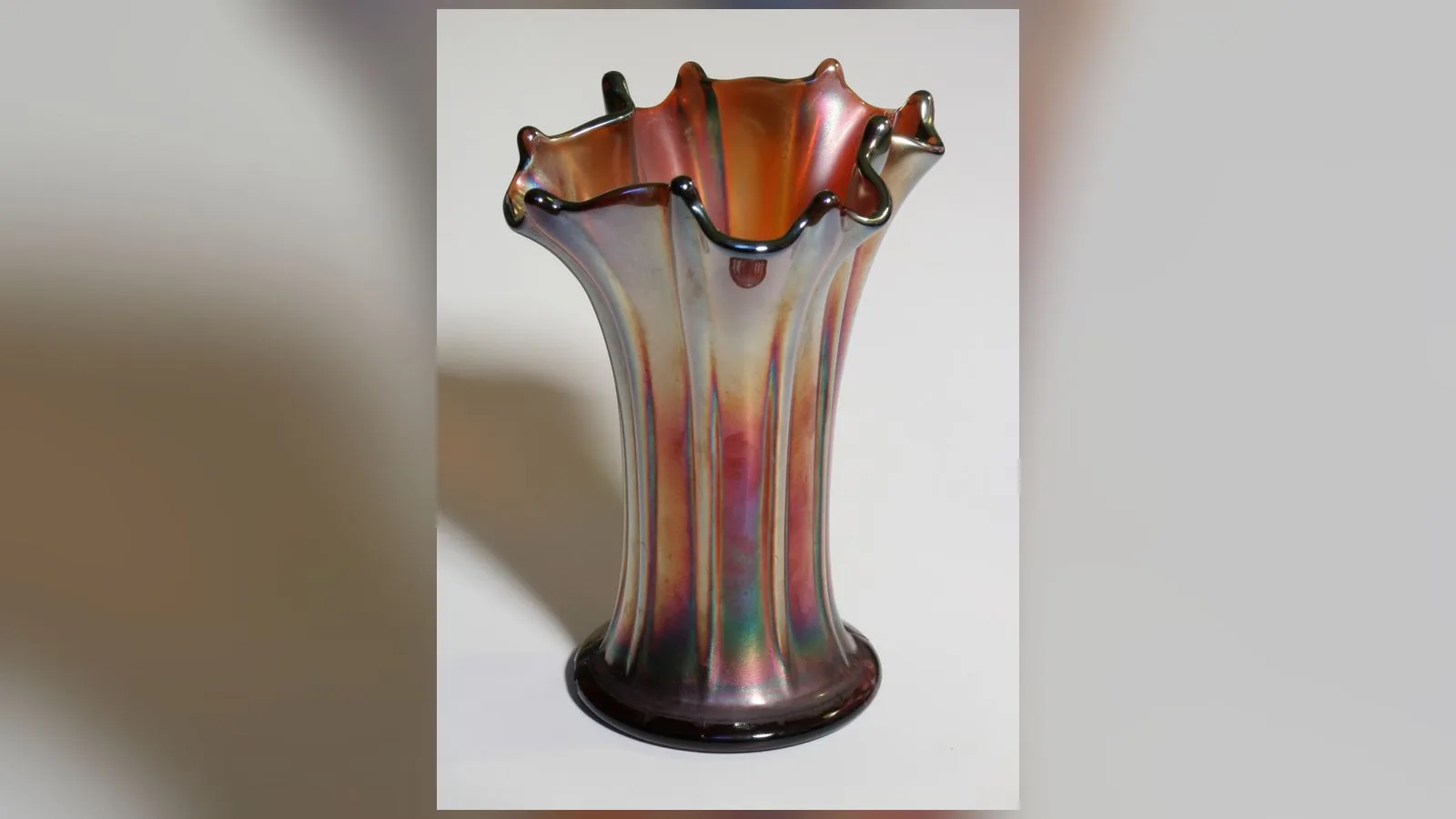
Carnival glass holds some of the highest auction records in American glass, up to $155,000 for a single vase. It also fills thrift store shelves at a few dollars a piece. Both are true at the same time. This guide shows where the money is and how to tell which side your piece is on.
The top of the market
These are the ten highest carnival glass auction prices, as tracked by Hooked on Carnival:
| Piece | Price | Year |
|---|
| Millersburg Peoples Vase, blue | $155,000 | 2018 |
| Northwood Wisteria Vase, emerald green | $140,000 | 2018 |
| Northwood Peacock and Urn Bowl, vaseline | $66,000 | 2019 |
| Northwood Tornado Vase, celeste | $60,000 | 2017 |
| Cleveland Memorial Souvenir Ashtray, marigold | $55,000 | 2020 |
| Fenton Goddess of Harvest Bowl, blue | $52,500 | 2014 |
| Millersburg Flowering Vine Compote, amethyst | $50,000 | 2019 |
| Millersburg Hobstar and Feather Vase, green | $50,000 | 2012 |
| Northwood Poppy Show Plate, aqua opal | $45,000 | 2011 |
| Millersburg Morning Glory Pitcher, amethyst | $42,000 | 2017 |
Look at the colors. Blue, emerald green, vaseline, celeste, amethyst, aqua opal. Only one piece in the top ten is marigold, and it is a souvenir ashtray made in tiny numbers. Look at the makers too: Millersburg and Northwood dominate. Color and maker are the two things this guide will help you check.
The bottom of the market
Now the other end. LoveToKnow's carnival glass guide puts common single pieces at $30 to $50 at auction, and Wikipedia's summary of the market is that prices range "from a few dollars to thousands." Wikipedia also notes that marigold "is the most common colour and generally commands lower prices." Most carnival glass in family collections is marigold bowls, vases and plates, which is why most of it sells at the low end.
Step one: know what you are looking at
Carnival glass is pressed glass with an iridescent surface. In Wikipedia's words, it "gets its iridescent sheen from the application of metallic salts while the glass is still hot from the pressing." It started in 1908, when Fenton introduced it under the name "Iridill," peaked in the 1920s, and most US production happened before 1925. The name came later: collectors adopted "carnival glass" in the 1950s because pieces were sometimes given as prizes at carnivals and fairs.
The main US makers were Fenton, Northwood, Imperial, Millersburg, Westmoreland, Dugan (later Diamond), Cambridge and US Glass. Northwood often marked its pieces with an underlined N inside a circle on the inside or base; many other makers did not mark their glass at all, so pattern identification is how most pieces are attributed.
Step two: find the base color
The surface color is not the color collectors mean. The color that matters is the glass underneath. Wikipedia describes the test: find an area that had no mineral salts applied, often the base, and look at light through it.
- Turn the piece over and find the base or the marie (the ring it sits on), where the iridescent spray is thin or absent.
- Hold it up to a window or a bright white light and look through that spot.
- Note the color you see through the glass: clear with an orange surface means marigold; purple means amethyst; deep blue means cobalt; green means green; a pale yellow-green means vaseline.
- If you see opalescent (milky) edges, note that too: aqua opal and other opalescent colors are among the most valuable.
A bowl that looks dark and purple on top can turn out to be marigold over clear glass, or true amethyst. The base color decides which price range it belongs to.
Do this test in daylight if you can. Warm indoor bulbs tint everything yellow and can make clear glass look amber or vaseline. A phone flashlight held behind the base, in a room with the lights off, works well too. If two people looking at the same spot disagree on the color, ask a carnival glass club: base color calls are what their members do all day.
Step three: the pattern and the shape
Patterns have names (Peacock and Urn, Grape and Cable, Wisteria), and collectors price each pattern in each color and shape separately. A pattern that is common in marigold bowls can be rare as a plate in blue. Once you know the base color, search sold listings for the pattern name, color and shape together.
Shape matters more than people expect. Plates are generally scarcer than bowls in the same pattern, which is why one of the records above is a plate. Pitchers, compotes and tall vases are also more sought after than small bowls.
Edges matter too. Many carnival bowls were shaped after pressing, with ruffled, crimped or straight edges, and collectors track those shapes separately. A pattern that is common with a ruffled edge can be scarcer with a straight one, so note the edge when you search.
Reproductions and later pieces
Fenton stopped making carnival glass in the late 1920s, later restarted, and the company closed in 2007, according to Wikipedia. Later carnival glass from Fenton and other makers exists in large numbers and is collected separately from the original period. Newer pieces tend to have brighter, more uniform iridescence and are often marked. If a piece looks too perfect, compare it with photos of verified originals before you price it as early glass.
Condition on iridescent glass
| Problem | Effect |
|---|
| Chips on ruffled edges | The most common damage; lowers value a lot on any piece |
| Worn iridescence | Rubbed areas, often on the high points of the pattern, reduce value |
| Cracks, including fine ones | Cut value sharply; check by tapping gently or holding to light |
| Weak or uneven iridescence from the factory | Lowers desirability; collectors prize strong, even color |
Photographing it for a sale or a second opinion
Iridescent glass photographs badly under direct flash. Shoot it near a window in daylight, from a few angles, so the color play shows. Add one photo held up to the light showing the base color, and one of the base or interior showing any maker's mark. A buyer or specialist can usually identify the pattern from good photos, and good photos are what get rare colors noticed.
Why marigold is everywhere
Marigold was the color the factories made most, for the mass market that carnival glass was aimed at. It was inexpensive, decorative and given away as prizes, so it ended up in a huge number of homes, and much of it survived. Rarer base colors were made in smaller runs, and some colors were made only for short periods or by specific makers. That is why the auction records are almost all in colors other than marigold. If you are sorting a collection, sort by base color first: set aside anything that is not clear glass under an orange surface, and research those pieces one at a time.
Where to sell it
| Option | Good for |
|---|
| Carnival glass collector clubs and their auctions | Rare colors and scarce patterns |
| Online marketplaces | Common marigold pieces and mid-range items |
| Antique malls and consignment | Mixed lots |
What to do with yours
| You have | Best move |
|---|
| Marigold bowls and small vases | Expect the common range. Sell individually or as a lot. |
| Amethyst, blue, green or opalescent base color | Identify the pattern and check sold listings for that exact color and shape. |
| Plates, pitchers, compotes, tall vases | Worth researching individually even in marigold. |
| Marked Northwood pieces in unusual colors | Consider a carnival glass specialist or auction. |
| Chips, cracks or worn iridescence | Value drops sharply; sell as decorative glass. |
For the colored glass that often sits next to it, see the depression glass value guide. For other glassware, the crystal and glassware guide is the place to start.