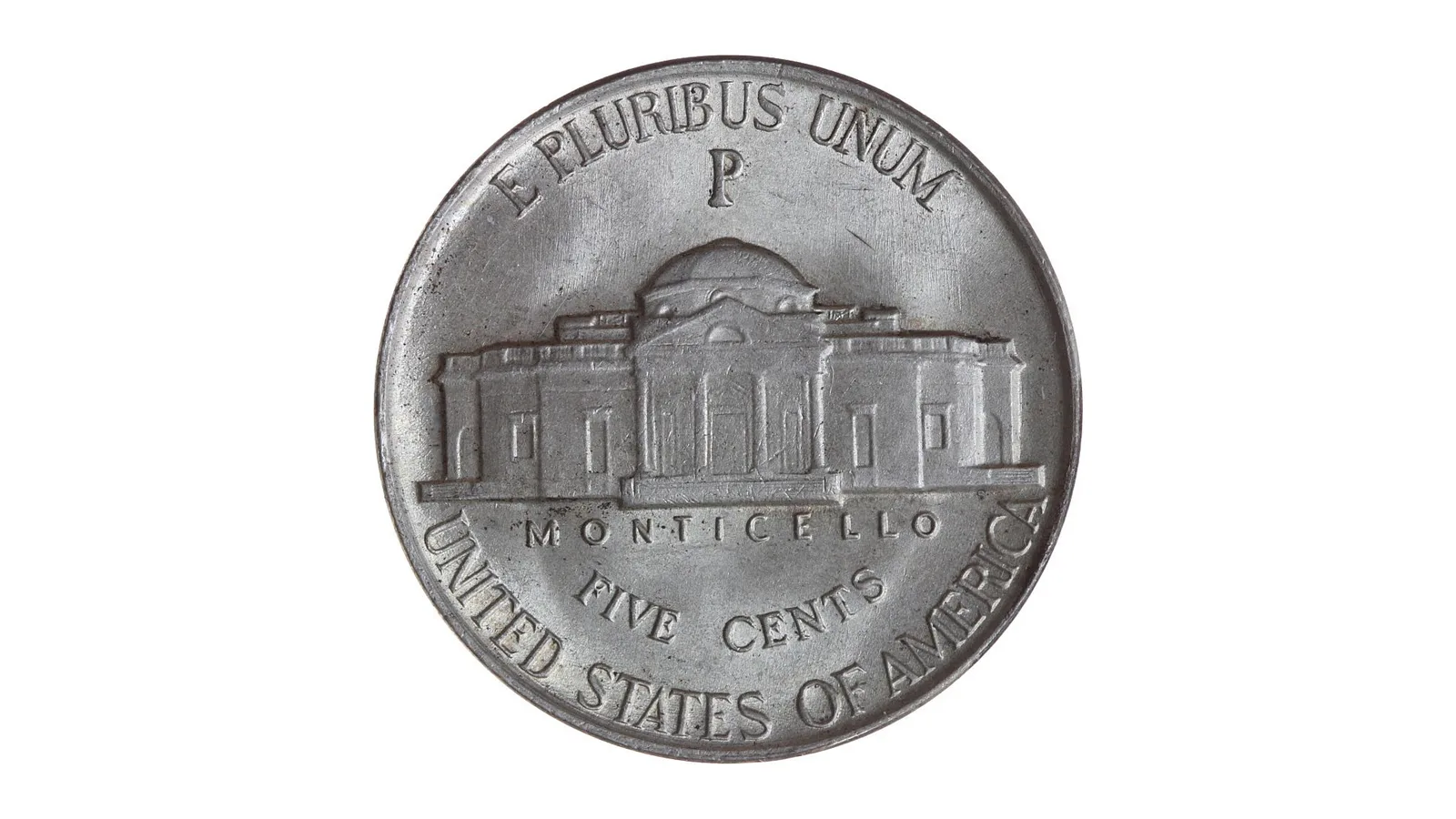
The Jefferson nickel has been in production since 1938, and almost every one is worth five cents. The exceptions cluster in specific years. Find your coin's era below and you will know in a minute whether it is worth a closer look.
Find your era first
| Era | How to recognize it | Where the mint mark is | Worth checking? |
|---|
| 1938 to 1941 | Original design, copper-nickel | Reverse, right of Monticello (none on Philadelphia) | Yes: 1938-D, 1939-D, 1939-S, and the 1939 doubled Monticello |
| 1942 to 1945 (war nickels) | Large mint mark above Monticello's dome, including P | Reverse, above the dome | Always: 35% silver |
| 1946 to 1964 | Copper-nickel again | Reverse, right of Monticello | Mainly the 1950-D |
| 1965 to 1967 | No mint marks at all | None | Rarely |
| 1968 to 2003 | Mint mark moves to the front | Obverse, near the date | Only in top grade or with errors |
| 2004 and 2005 | Westward Journey designs | Obverse | Small premiums in uncirculated |
| 2006 onward | Jefferson facing forward | Obverse | Rarely |
The coincollecting.com guide to the series puts it bluntly: most nickels from 1946 onward are worth face value in circulated grades. The money is in the first three eras, plus condition and errors across all of them.
1942 to 1945: the war nickels
To save nickel for the war effort, the Mint changed the alloy to 56% copper, 35% silver and 9% manganese, and marked the change with a large mint mark above Monticello's dome. Wikipedia notes the P on these coins was the first time the Philadelphia mint's mark had appeared on a US coin. That big letter over the dome is how you spot one in two seconds.
Every war nickel weighs 5 grams, so each contains 1.75 grams, or 0.05626 troy ounces, of pure silver. Melt value is that times the silver spot price:
| Silver spot price per ounce | Melt per war nickel | Roll of 40 |
|---|
| $30 | $1.69 | $67.51 |
| $40 | $2.25 | $90.02 |
| $50 | $2.81 | $112.52 |
| $60 | $3.38 | $135.02 |
| $75 | $4.22 | $168.78 |
CoinWeek notes that circulated war nickels trade in rolls for about their silver value. So a worn war nickel is a silver coin, priced off spot, and any date in the set is worth pulling out of circulation. For other junk silver in the same drawer, the gold and silver guide covers it, and the Franklin half dollar guide walks through the same melt math for 90% silver halves.
One warning. A 1944 nickel with no mint mark above the dome is not a genuine war nickel. All 1944 nickels were struck in the wartime alloy with the large mint mark, and the no-mint-mark 1944 pieces are known counterfeits made by Francis LeRoy Henning in the 1950s. They are a curiosity, not a rarity.
The key dates
Two dates carry most of the premium in the regular series. Mintages from US Mint records as published by Gainesville Coins and CoinWeek.
| Date | Mintage | Why it matters |
|---|
| 1950-D | 2,630,030 | The lowest mintage Jefferson nickel |
| 1939-D | 3,514,000 | Second lowest, and scarcer in high grade |
| For comparison: 1943-P | 271,165,000 | A typical war year |
The 1950-D is the textbook example of a key date that is not hard to find. Gainesville Coins, citing NGC, calls it the most widely hoarded nickel since the 1938-D Buffalo, because collectors recognized it as a key date from the start and saved it by the roll. Their values:
| 1950-D grade | Value | With full steps |
|---|
| Very Fine | $5 | Not applicable |
| Extremely Fine | $7 | Not applicable |
| MS61 | $9 | $13 |
| MS63 | $15 | $22 |
| MS65 | $28 | $45 |
| Top auction record | $633 (MS66+) | $17,250 (MS67 full steps) |
So a 1950-D is a $5 to $30 coin for most people. The big numbers belong to a handful of perfectly struck examples.
Full steps: the detail that moves prices
Monticello on the reverse sits on a set of steps. Wikipedia: "full step" nickels are those where "all six steps appear clearly," and they are more collectable. Most Jefferson nickels were struck softly in the center, so the steps blur together. The 1950-D record above shows the effect: same date, same top grade range, and full steps take it from hundreds to five figures.
To check, use a 10x loupe with light from the side. Count the horizontal lines below the building. Each one must run unbroken across, with no nicks or marks cutting through. Only bother on uncirculated coins: wear removes the steps first.
The varieties that sell
Ranges for uncirculated coins (MS60 and up) from coincollecting.com, with CoinWeek's figures where it gives a wider range:
| Variety | What to look for | Value |
|---|
| 1942-D D over D | A second D punched over the first, right of Monticello | $1,500 to $10,000 |
| 1939 doubled Monticello | Doubling on MONTICELLO and FIVE CENTS on the reverse | $200 to $1,000 |
| 1943-P 3 over 2 | The ghost of a 2 under the 3 in the date | $250 to $750 (CoinWeek: $125 in XF up to $5,500 in MS67 full steps) |
| 1943-P doubled eye | Doubling on Jefferson's eye | $100 to $700 |
| 1945-P doubled die reverse | Doubling on the reverse lettering | $8 to $800 (CoinWeek: $52 in XF up to $11,500 in MS66 full steps) |
Wikipedia explains the 1943-P overdate: a die from the previous year was reused, so a 2 is visible under the 3. Doubling from a doubled die is crisp and rounded. Flat, shelf-like doubling is machine doubling and adds nothing. The error coin guide shows the difference.
The modern designs, 2004 onward
In 2004 and 2005 the Mint ran the Westward Journey series to mark the bicentennial of the Lewis and Clark expedition. The 2004 coins carry a Peace Medal and a keelboat on the reverse; the 2005 coins carry an American bison and the Pacific coast with the words "Ocean in view! O! The joy!", along with a new close-up portrait of Jefferson. In 2006, Monticello returned to the reverse and the obverse changed to a forward-facing Jefferson designed by Jamie Franki, which is still in use.
These coins are collected as a set and carry small premiums in uncirculated condition. In circulation they are worth five cents. If you are sorting a jar, put the Westward Journey coins aside for a set or for kids who collect, not for sale.
Watch for altered key dates
Key dates attract fakes. The classic trick on any key date coin is adding a mint mark to a common Philadelphia coin, or altering a date digit. On a 1950-D, check the D under a loupe: an added mint mark often shows a seam around it, sits at a slightly different height, or has a different surface color from the field around it. Compare with a known genuine 1950-D or a published photo of the mint mark before you pay a premium. For the war nickels, remember the Henning 1944 above: the absence of a mint mark is itself the tell.
What to do with a jar of nickels
| You found | Do this |
|---|
| War nickels (big letter over the dome) | Keep them. Sell by the roll at melt, or hold them as silver. |
| 1938 to 1941 coins | Check for 1939-D, 1939-S and the doubled Monticello. The rest are worth a small premium at most. |
| A 1950-D | Check the grade honestly. Circulated is $5 to $7. |
| Bright uncirculated coins of any date | Check the steps under a loupe before spending. |
| Everything from 1946 onward, circulated | Five cents. Spend them. |
The Jefferson replaced the Buffalo nickel in 1938, and old jars often hold both. For anything else in the jar, start with the coin value guide.