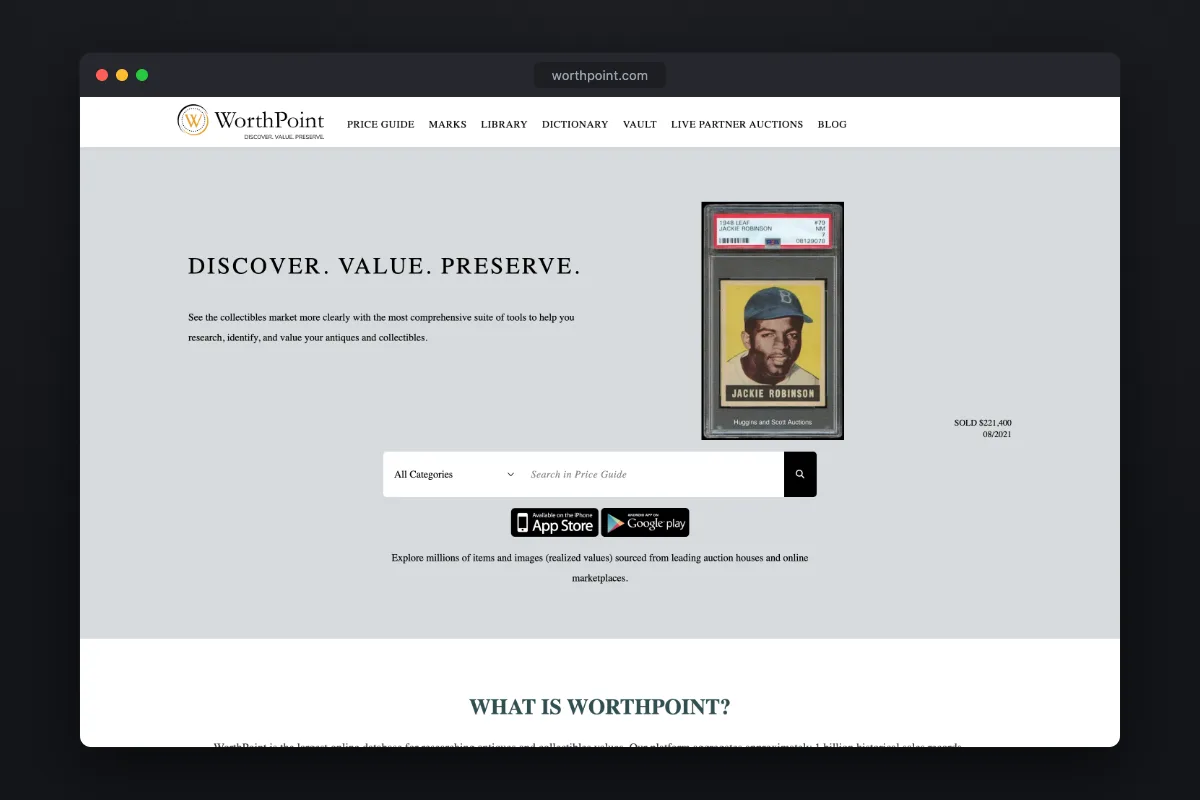
WorthPoint and Curio both answer "what is this worth?", but in opposite ways. WorthPoint is a database of what things actually sold for; you search it. Curio is an app that looks at your photo and estimates a value. One is evidence, the other is speed.
Disclosure: this site is Value Identifier, one of the tools compared. We say where it loses, and every other price is from the vendor's own page or App Store listing, checked October 21, 2026.
WorthPoint2/6 rows
$26.99/mo or $249.99/yr
Choose it if you price antiques or collectibles often and need real sold records as proof.
Curio3/6 rows
3 free scans, then in-app plans
Choose it if you want a fast photo estimate on your phone and the best-rated app.
Value Identifier4/6 rows
Free: 1 scan a day. Web pass $4.99/week or $24.99/year
Choose it if you want a photo estimate in the browser without installing anything.
| WorthPoint | Curio | Value Identifier |
|---|
| How it values | Database of past sold prices | AI estimate from online listings | AI estimate from sold prices found online |
| Free plan | None | ✓ 3 free scans | ✓ 1 free scan a day, no account |
| Price | $26.99/mo or $249.99/yr (App Store) | In-app plans from $4.99 | ✓ $4.99/week or $24.99/year on the web |
| Identify from a photo | No, you search by keyword | ✓ Yes | ✓ Yes |
| Browse actual sold records | ✓ Yes, hundreds of millions | No | No |
| Works in a browser | ✓ Yes | No, iOS and Android only | ✓ Yes |
| App Store rating | 2.1 from 114 | ✓ 4.8 from 16.7k | 4.2 from 12 |
The short answer
If you need to know what something actually sold for, with dates and photos of the sales, use WorthPoint. If you want to point your phone at an object and get a ballpark in seconds, use Curio. Dealers and serious collectors tend to need the first; people clearing out a house usually need the second.
Where WorthPoint wins
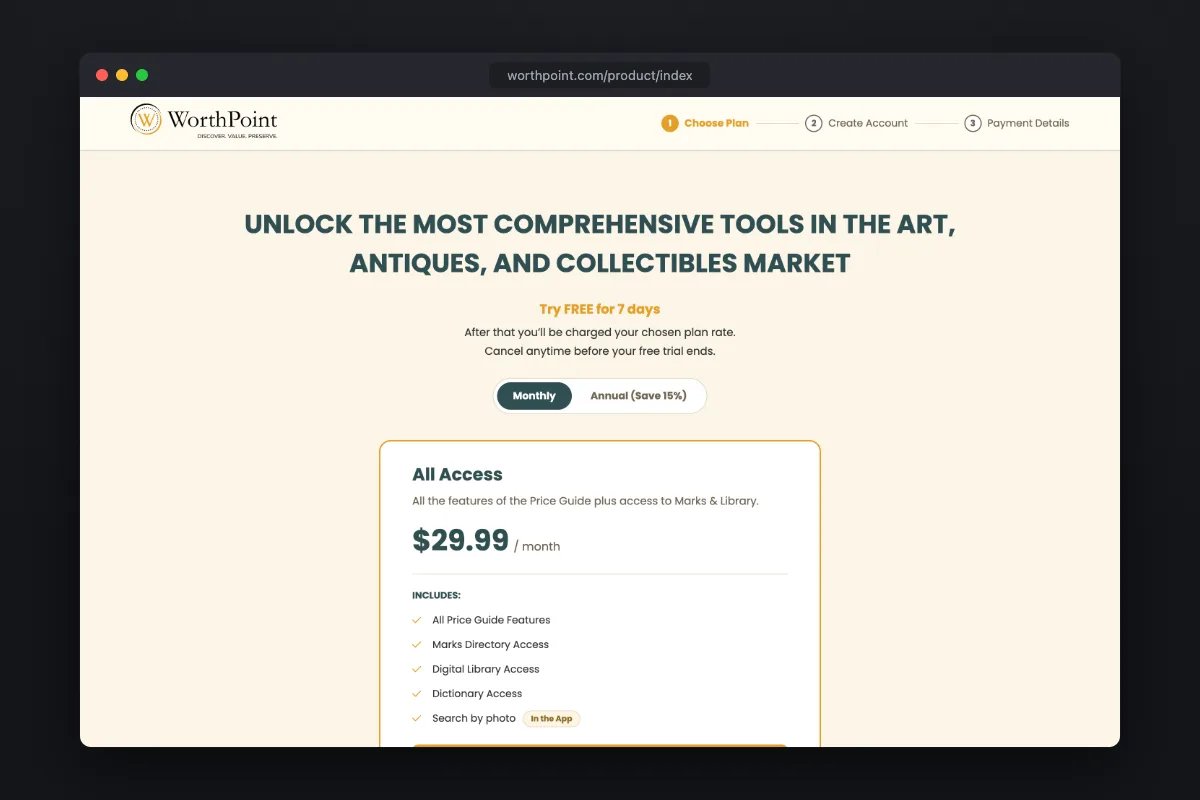
Evidence. WorthPoint aggregates past sales from about 350 sources, including auction houses and eBay, into a searchable price guide its site describes as hundreds of millions of sold prices. You see what comparable items fetched, when and where, which is what you need before you price something for sale or argue with a buyer. Its MARKS add-on identifies pottery, porcelain and silver marks. The catch: there is no free plan, the App Store lists the Price Guide at $26.99 a month or $249.99 a year, you have to know what to search for, and its app is rated 2.1 stars.
Where Curio wins

Speed and ease. Curio identifies the object from a photo and gives an estimated value drawn from online listings, so you do not need to know the maker or the model first. It is one of the best-rated apps in the category (4.8 stars from over 16,000 ratings) and gives you 3 free scans. Curio itself describes its values as a starting point and suggests a professional for formal appraisals. It runs only on iPhone and Android.
Where Value Identifier fits

Value Identifier is the tool on this site. You take or upload a photo, it identifies the item and returns an estimated value range in dollars, based on recent sold prices the model finds online. It works in the browser with no account: one free scan a day. The web pass is $4.99 a week or $24.99 a year; the iPhone app charges more for the same thing ($6.99 a week or $34.99 a year), so the web is the cheaper way to buy it.
Where it loses: it is an estimate, not a database of sales you can browse, and it does not always show the listings behind a number. Its iPhone app is new, with 12 ratings. Use it to find out quickly whether something is worth a closer look, then check sold listings before you sell anything valuable.
How to use them together
A sensible routine: scan first to learn what the thing is and whether it is worth anything, then search sold records for the exact item before you price it. For coins and paper money, our guides on star notes and coin values show how much the details change the price.