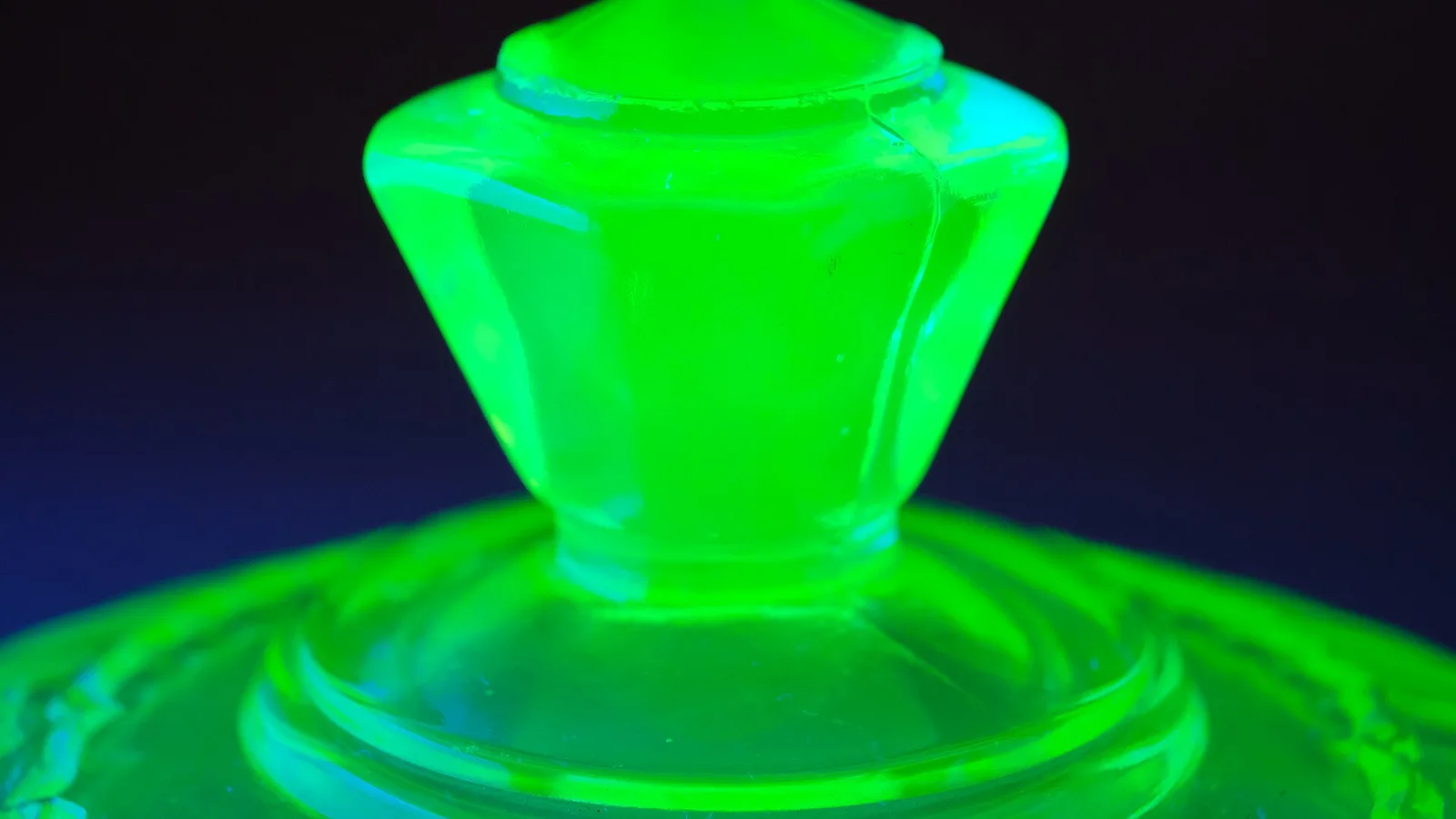
Every piece of uranium glass glows green under a blacklight, and that is exactly why the glow alone is worth nothing. What sells is the object: its age, its maker, its form and its condition. Here is how to confirm you have uranium glass, and then how to tell a $10 dish from a $3,500 lamp.
Step one: the blacklight test
Uranium glass is glass with uranium added to the mix before melting, for color. Wikipedia puts the usual proportion at trace levels up to about 2% uranium by weight, with some 20th century pieces made with much more. Its normal color ranges from yellow to green, and it "fluoresces bright green under ultraviolet light." That glow is the only reliable test.
- Get a UV flashlight. The inexpensive 365 nm kind gives the clearest result.
- Darken the room as much as you can.
- Shine the light on the glass. Uranium glass lights up a vivid green from inside the glass, not just on the surface.
- Compare with a piece of ordinary glass under the same light. Ordinary glass stays dark or turns faintly purple from the light itself.
If it glows, you have uranium glass. That tells you what it is made of. It does not tell you what it is worth.
Step two: name the color correctly
Collectors use specific names, and sellers misuse them all the time. These definitions are from Wikipedia:
| Name | What it means |
|---|
| Vaseline glass | Transparent or semi-transparent uranium glass in pale yellowish-green, named in the 1930s after the look of petroleum jelly at the time |
| Custard glass | Opaque or semi-opaque pale yellow |
| Jadite | Opaque or semi-opaque pale green (originally a trademark, often spelled "jadeite" today) |
| Depression glass (green) | Transparent pale green; "depression glass" itself just means glass made during the Great Depression, uranium or not |
| Burmese glass | Opaque glass shading from pink to yellow |
The important caveat, again from Wikipedia: names like vaseline, custard and jadite are often applied by appearance alone, regardless of uranium content. A piece sold as "vaseline glass" may not glow at all. The blacklight settles it.
For green glass from the 1930s specifically, the depression glass value guide covers patterns and prices; much of it overlaps with uranium glass.
A note on flashlights
Not all UV lights are equal. The common 395 nm flashlights give off a lot of visible purple light, which can make ordinary glass look like it is glowing faintly and makes the real glow harder to judge. A 365 nm light gives off much less visible light, so a true uranium glow stands out and a non-glowing piece stays clearly dark. If you sort glass often, the 365 nm kind is worth the small extra cost.
Also check the whole piece. Some glass has uranium in only part of it, such as an opalescent edge, a handle or a decorative trim, and that part alone will glow.
Step three: what the piece is
Once you know it glows, value comes from everything else: age, maker, form, rarity and condition. The best illustration is what the top pieces have actually sold for. These results were compiled by Wealth Gang from auction records:
| Piece | Sold for |
|---|
| Art Deco Saturn table lamp from the 1939 World's Fair (Toomey and Co.) | $3,500 |
| Antique Bohemian uranium glass bonbonniere with gilded fruit finial | $2,345 |
| Art Deco painted metal lighted fishbowl with uranium bowl | $1,700 |
| Pair of uranium glass candlestick holders | $1,700 |
| French gilt brass mounted vaseline glass perfume bottles | $1,400 |
| Vaseline green cut glass knife rests | $1,100 |
| Antique uranium glass vases | $1,100 |
| Sterling silver mounted uranium glass decanters | $950 |
| Jack in the Pulpit uranium glass vase | $750 |
Look at what these have in common. Almost every one is either old (19th century European work, Art Deco from the 1920s and 1930s), combined with another valuable material (gilt brass, sterling silver), or an unusual form (a Saturn lamp, a lighted fishbowl). None of them is an ordinary pressed glass dish. That is the dividing line in this market.
Where most uranium glass sits
Most uranium glass people own is pressed tableware from the 1920s through the 1940s: bowls, plates, candy dishes, butter dishes, measuring cups. It was made in large quantities, and it sells mostly by pattern, like depression glass. Common pieces are worth a few dollars to a few tens of dollars. Uranium glass has a large and enthusiastic collector base, which keeps demand steady, but the supply of ordinary tableware is large too.
When it was made, and why that matters
| Period | What happened (Wikipedia) |
|---|
| 1830 to 1848 | Franz Xaver Riedel produces uranium glass in Bohemia, naming the colors annagelb and annagrün after his daughter |
| 1880s to 1920s | The period of greatest popularity |
| 1942 to 1958 | US production stops; uranium supplies taken for the Manhattan Project |
| After 1958 | Several US firms resume, including Fenton and Mosser |
| Today | Fenton, Mosser, Gibson and others continued the vaseline tradition; modern pieces exist |
The practical consequence: modern uranium glass exists and glows exactly like the old. Pieces from makers still producing in the style, and newer novelties, sell for far less than antique and Art Deco examples. Age has to be established from the form, the mold quality, the maker's marks and wear, not from the glow.
One more consequence of that timeline: a piece that is clearly Art Deco in style, with matching wear and period hardware, is a much safer bet than a plain dish that could have been made in any decade.
Is it safe?
Wikipedia's summary: uranium glass "can register above background radiation on a sufficiently sensitive Geiger counter, although most pieces of uranium glass are considered to be harmless and only negligibly radioactive." A study of a private collection found the radiation dose rates "posed no danger to the public or to conservators." Collectors display it openly. If you are unsure about using an old dish for food, keep it for display; that is what most collectors do anyway.
Buying and selling tips
- Never pay a premium for a "vaseline" label without a UV photo. Sellers use the word for any pale yellow-green glass.
- Price by the object, not the glow. Search sold listings for the pattern or form plus "uranium" or "vaseline," and compare with the same piece in non-uranium glass. The gap is the real uranium premium, and for common tableware it is small.
- Look for maker's marks and labels. Old paper labels and marks help date a piece and separate vintage production from later reissues.
- Check for chips under UV. Fluorescence makes chips and cracks along rims easier to see, which is useful both when buying and when describing your own piece honestly.
What to do with yours
| You have | Best move |
|---|
| Pressed glass dishes that glow | Identify the pattern, then check sold listings like any depression era glass. |
| Blown, cut or gilded pieces, especially European | Research individually; consider an auction house that handles glass. |
| Art Deco lamps or figural pieces | These are the top of the market; get them looked at by a specialist. |
| Modern novelty pieces (marbles, beads, new figurines) | Fun to own, low resale value. |
| Anything sold to you as "vaseline" that does not glow | It is not uranium glass; price it as ordinary colored glass. |
When you photograph uranium glass for a sale, include one picture in normal light and one under UV. Buyers want proof of the glow, and the UV shot is the one that sells it. For white opaque glass from the same era, see the milk glass value guide, and for iridescent glass, the carnival glass guide. The crystal and glassware guide covers the rest of the cabinet.