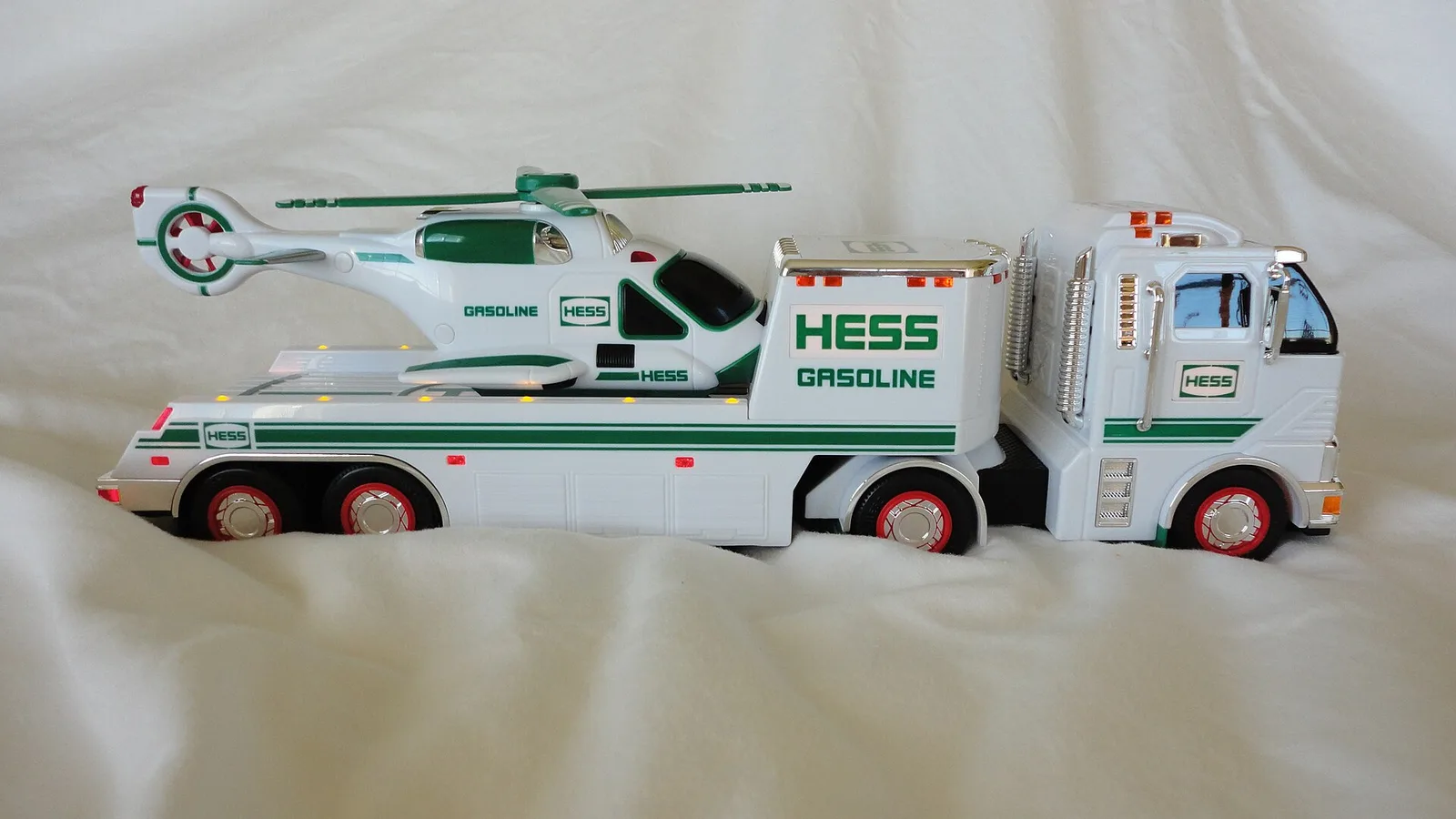
Hess has released a toy truck every holiday season since 1964. Most of them are worth roughly what they cost. A handful from the 1960s and 1970s are worth hundreds to thousands, but only in the box. Find your year below and check the box before anything else.
The trucks that matter
Mental Floss compiled the eight most valuable Hess trucks. Every value assumes excellent condition with the original packaging:
| Year | Model | Value | Why |
|---|
| 1975 | Barrel Truck, USA-made variant | $3,500+ | Only 20 to 40 made; most were made in Hong Kong |
| 1967 | "Red Velvet" Tanker | About $2,500 | Red velvet display base that was easily damaged |
| 1964 | Tanker Truck | $1,800+ mint in box | The first Hess toy, originally $1.39 |
| 1969 | "Woodbridge" Tanker | About $1,500 | Box reads "Home Office in Woodbridge, New Jersey" |
| 1970 | Fire Truck | About $525 | First Hess fire truck, detachable ladder |
| 1977 | Tanker with black switch | About $375 | Some have a black switch instead of red |
| 1980 | Training Van | About $375 | First Hess toy in a one-piece box |
| 2002 | Truck and Airplane | About $75 | The newest truck on the list |
Wikipedia puts the 1964 tanker at approximately $2,500 today, higher than the Mental Floss figure. Treat the 1964 as a $1,800 to $2,500 truck when it is complete and boxed.
Two of the most valuable trucks are valuable because of a detail, not the year: the 1975 barrel truck only if it is the USA-made version, and the 1977 tanker only with the black switch. Check those details before you assume anything.
One more caution on the list: values like these come from the best examples. A 1964 tanker with a torn box, missing insert or corroded battery contacts sells well below the headline number. The list tells you which years deserve a closer look, not what your particular truck will bring.
Why most Hess trucks are not worth much
Mental Floss explains the pattern: the early trucks are valuable because fewer were made and people played with them instead of saving them. From the 1980s on, collectors bought them to keep. In their words, collectors "treat the products and packaging with reverence," so modern trucks survive in huge numbers in perfect condition. That is why the 2002 truck at $75 is the newest one on the list, and why most trucks after the 1980s sell for around what they cost new.
The box is half the value
For Hess, the packaging is not an extra. Values above assume "the truck being not only in excellent condition but with a pristine package," as Mental Floss puts it. Check these, in this order:
- Is there a box at all? A loose early truck sells for a fraction of a boxed one.
- Is it the right box? The 1969 Woodbridge is identified partly by its box text. The 1967 Red Velvet's value depends on its velvet base, which was easily damaged.
- Are the inserts and extras there? Many trucks came with cardboard inserts, ladders, barrels, helicopters or smaller vehicles. Missing pieces cut the price.
- Do the lights work? Most Hess trucks have battery-powered lights and sounds. Check for corrosion in the battery compartment, the most common damage on old trucks. Remove old batteries before storage.
- Has it been played with? Scuffs, missing decals and broken parts matter more on rare years, where buyers are paying for condition.
How Hess trucks were sold
According to Wikipedia, Hess sold the toys at its gas stations during the Christmas season starting in 1964. The 2014 truck, the 50th anniversary model, was the last one sold at Hess stations, after the retail stations moved to Speedway. Since 2015 the trucks have been sold only through the company's website. Notable milestones in the line include the 1966 tanker ship based on the Hess Voyager, the 1993 Patrol Car (the first main toy that was not a truck), the 2004 SUV with motorcycles for the 40th anniversary, and the 2021 Cargo Plane and Jet.
None of those milestones made the later toys rare. They were made in large numbers for collectors who kept them boxed.
Anniversary trucks are a good example. Buyers sometimes assume a 40th or 50th anniversary model must be special, but anniversary releases were made for the same collector market as every other year, and they survive in the same condition. Check sold listings for the specific year; do not price by the anniversary label.
Quick reference: what is yours worth?
| Your truck | Realistic expectation |
|---|
| 1964 to 1970, complete and boxed | Hundreds to a few thousand dollars, depending on model |
| 1964 to 1970, loose or incomplete | A fraction of the boxed value; check sold listings for loose examples |
| 1975 barrel truck | Check whether it is the rare USA-made variant; most are not |
| 1977 tanker | Check the switch color; black is the valuable version |
| 1980s onward, boxed | Roughly original price or modestly above; the 2002 truck sells for about $75 |
| Any year with battery corrosion or missing parts | Sell as a display or play truck |
Identify the year
If you have the box, the year is usually printed on it. Without a box, compare the truck with the year-by-year photos on the official Hess toy truck website, which shows the full line, or with sold listings for the year you suspect. Pay attention to the cab shape, the trailer type (tanker, barrel, fire ladder, van) and the accessories, since several years share similar tankers.
Storing them so they keep their value
- Take the batteries out. Leaking batteries corrode contacts and stain the plastic, and corrosion is the most common damage on old trucks.
- Keep boxes dry and flat. Basements and attics warp and stain cardboard. A box in good shape is part of the value.
- Keep the inserts. The cardboard inside the box is part of a complete example.
- Out of direct sun. Sunlight fades the green and white plastic and the box art.
Should you hold them as an investment?
For trucks from the 1980s onward, there is little reason to expect much appreciation. The same thing that keeps them cheap now, millions of boxed examples kept by collectors, will still be true later. The trucks that became valuable did so because most of them were played with and thrown away, and that does not happen to a truck that goes straight into a closet. Buy new Hess trucks because you or a child will enjoy them, not as an investment.
The early trucks are different. Supply of complete, boxed examples from the 1960s and 1970s only shrinks, as boxes get damaged and trucks get separated from their parts. If you own one in good shape, keep it dry, keep the box safe, and sell when it suits you.
Either way, the habits that protect value are the same: batteries out, box dry, parts together. None of them costs anything, and all of them show up in the price when you sell.
How to sell them
Sell rare early trucks individually with photos of every side of the box, the inserts and the battery compartment. Search sold listings for the exact year and model, and for loose versus boxed, since the gap is large. For a run of boxed trucks from the 1990s and 2000s, a single lot often sells faster than individual listings, because the buyers are usually completing collections.
For other toys in the same bin, the toy value guide covers the general market, the Hot Wheels guide covers die-cast cars, and the model train guide covers the other holiday collectible people keep in boxes.