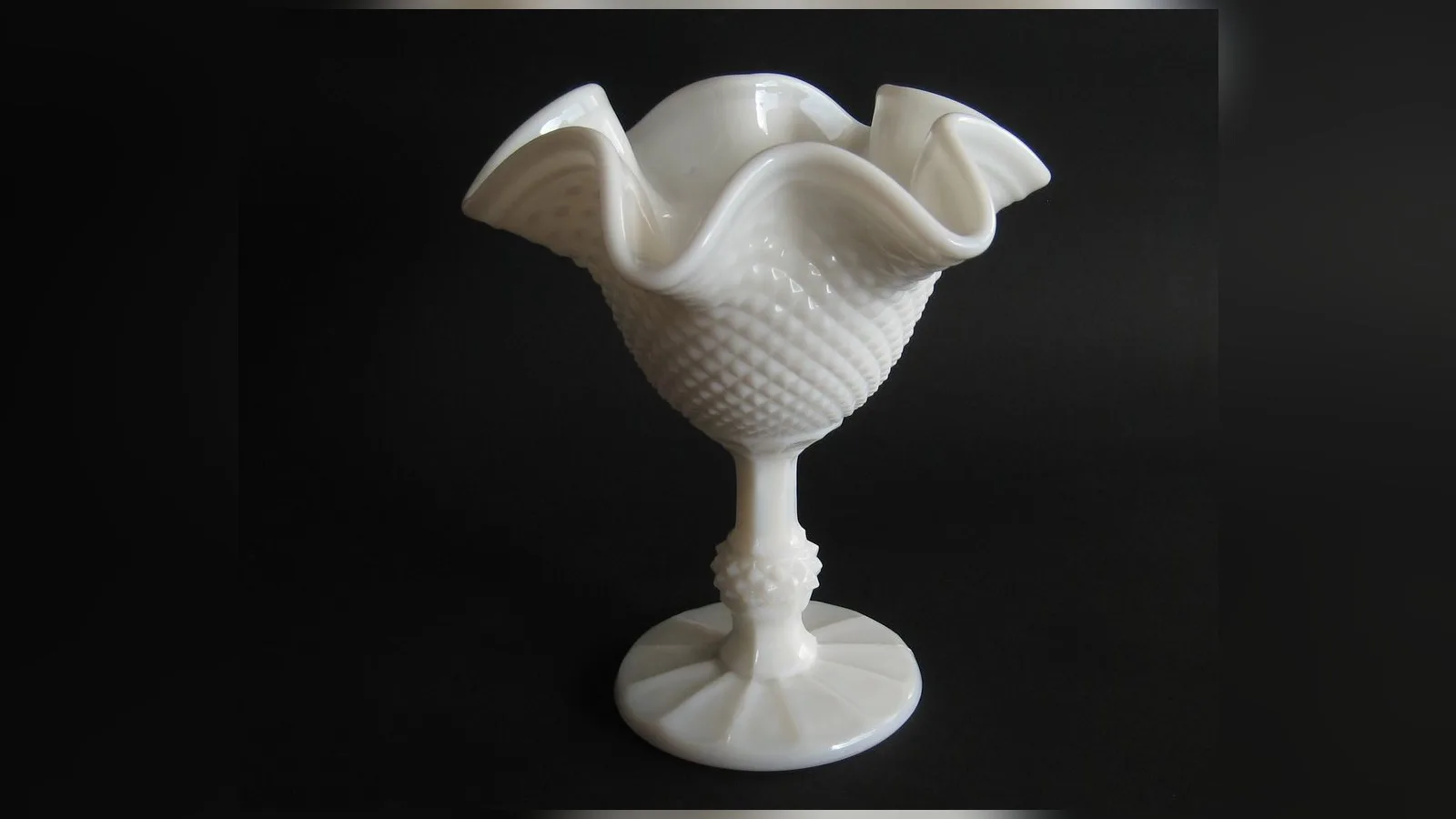
Milk glass is everywhere: thrift stores, estate sales, grandmother's china cabinet. Most of it sells for a few dollars. Pieces from certain makers, in certain forms, sell for $100 to $400, and a 1920s glass eagle from a gas pump sold for $4,000. The maker's mark and the form are how you tell them apart.
What milk glass is
Milk glass is opaque or translucent glass, usually milk white but also made in blue, pink, yellow, brown and black, according to Wikipedia. It was first made in Venice in the 16th century as a competitor to porcelain. In the US it was popular around the turn of the 20th century, made into dinnerware, lamps, vases and jewelry. Wikipedia notes that pieces made for the wealthy of the Gilded Age are known for delicate design, while Depression-era pieces of the 1930s and 1940s are less so.
The name is fairly recent. Some 19th century glassmakers called it "opal glass." You will see both names in old catalogs and listings.
Who made it
Wikipedia lists the notable US makers, including Fenton, Fostoria, Imperial, L.E. Smith, Westmoreland, Kanawha and Mosser. The maker is the first thing that separates valuable pieces from ordinary ones, so check the base.
| Maker | Mark to look for | What collectors want |
|---|
| Westmoreland | Intertwined "W" and "G", or "Westmoreland" in a keystone on pieces made after 1946 (per Wealth Gang) | Covered animal dishes and ornate covered pieces |
| Fenton | Often marked; many pieces are hobnail | Holiday punch bowl sets, hand-painted pieces, vases |
| L.E. Smith | Faint "L.E. Smith" mark on the base | Moon and Star pattern pieces |
| Fostoria | Often unmarked; identified by pattern | The "American" pattern, especially punch bowls |
| McKee | Varies by period | Early 1900s Art Deco vases and bowls |
| Atterbury | Usually identified by form | 19th century figural pieces |
Many milk glass pieces have no mark. In that case the pattern and form are the identification, and comparing against known examples is the only way.
What pieces have actually sold for
These examples come from Wealth Gang's roundup of valuable milk glass. Sold prices and asking prices are kept separate here, because the difference matters.
| Piece | Price | Type |
|---|
| 1920s to 1930s milk glass eagle from a White Eagle Oil gas pump (Carrell Auctions, late 2024) | $4,000 | Sold |
| Fenton holiday punch bowl set with cups | Over $400 | Sold, complete sets |
| Fostoria "American" punch bowl, restored | Upwards of $340 | Sold |
| Gillinder presidential glass busts, Lincoln and Washington (2019) | $180 | Sold at auction |
| McKee bowl | $110 | Sold at auction |
| Westmoreland covered animal dishes | Over $100 | Typical for ornate pieces |
| Atterbury John Bull salt and pepper shakers, late 1800s | About $100 | Sold |
| Plainer Westmoreland covered dishes | Upwards of $50 | Typical |
The $4,000 eagle is not tableware at all. It is advertising, which is its own collecting field with its own buyers. Among ordinary tableware, the ceiling is in the low hundreds, and it belongs to complete sets, early pieces and known makers.
Where most milk glass sits
Hobnail vases, compotes, candy dishes and planters from the mid-20th century were made in very large quantities and are the bulk of what turns up. Unmarked, common pieces sell for a few dollars to perhaps twenty or thirty. That is not a criticism; it is supply. Milk glass has a considerable collector following, as Wikipedia notes, but the supply of mid-century pieces is larger.
Old or new?
Wikipedia is direct: glassmakers continue to produce both original pieces and reproductions of popular collectible patterns. Several makers that produced vintage milk glass, or acquired the molds, kept producing similar pieces for decades. That means a hen on nest dish or a hobnail vase can be old or fairly recent. Clues to look at:
- The mark. Some makers changed their mark over time; a mark that belongs to a later period dates the piece.
- Wear on the base. Old pieces show fine scratches on the foot from decades of being moved across shelves. Uniform wear or none at all is a clue.
- Mold detail and finish. Compare with documented examples of the same pattern; quality varied between periods.
- The glow. Under a UV light, some older milk glass fluoresces, but this is not a reliable test on its own. For glass that glows green, see the uranium glass guide.
Why some pieces cost more than others
The price differences in milk glass come down to the same few things every time: who made it, when, how much work went into it, and whether it is complete. A 19th century piece pressed in a detailed mold by a maker like Atterbury was produced in small batches. A mid-century hobnail vase came off a production line by the thousands. Covered dishes need their lids, and punch bowls need their cups, so complete examples are scarcer than the pieces that survive alone. Advertising and figural pieces, like the gas pump eagle, are scarce because they were made for a purpose other than the dinner table and most were thrown away. When you sort a box of milk glass, look for those signals first: an old mark, a complex mold, a complete set, or a form that was not made for everyday use.
Care matters too. Hand wash milk glass in warm water with mild soap. Dishwashers can dull the surface and cause the cloudiness that buyers mark down, and harsh scrubbing damages painted decoration.
Condition
| Problem | Effect |
|---|
| Chips on rims, feet or lid edges | Reduces value significantly; check by running a finger around every edge |
| Replacement lids | On covered dishes, a lid that does not fit snugly may be a replacement, which can halve the value (per Wealth Gang) |
| Staining or cloudiness | Lowers appeal; usually from dishwashers or long storage |
| Worn paint on decorated pieces | Lowers value on hand-painted Fenton and similar pieces |
Colored milk glass
Milk glass is not only white. Wikipedia lists blue, pink, yellow, brown and black among its colors, and makers produced opaque colored versions of popular patterns. Wealth Gang notes that colored pieces are still considered milk glass as long as they keep the opaque, milky finish, and points to L.E. Smith's Moon and Star pieces in colors as collector favorites. Colored pieces are less common than white in most patterns, so check sold listings for the specific color rather than assuming a white piece's price.
Research a piece in ten minutes
- Check the base for a mark and note it exactly.
- Name the pattern: hobnail, grape, Moon and Star, lace edge, paneled. Describe it in a search and compare images.
- Identify the form: covered dish, compote, vase, punch bowl, figural piece.
- Check lids and edges for fit and chips.
- Search sold listings for maker, pattern and form together.
Where to sell
| Option | Good for |
|---|
| Online marketplaces | Marked pieces, covered animal dishes, complete sets |
| Antique malls and flea markets | Common hobnail and mixed lots |
| Collector clubs (such as the National Milk Glass Collectors Society) | Rare and early pieces |
| Auction house | 19th century, figural and advertising pieces |
What to do with yours
| You have | Best move |
|---|
| Unmarked hobnail vases and compotes | Sell as a lot or keep for use; expect a few dollars each. |
| Marked Westmoreland, Fenton or L.E. Smith pieces | Check sold listings by maker and pattern; sell individually. |
| Covered animal dishes | Check the lid fit and the mark; the good ones sell individually. |
| Complete punch bowl sets | Sell as a set; completeness is the value. |
| 19th century or advertising pieces | Research individually; consider an auction house. |
For the colored glass that usually shares the cabinet, see the depression glass value guide, and for everything else, the crystal and glassware guide.