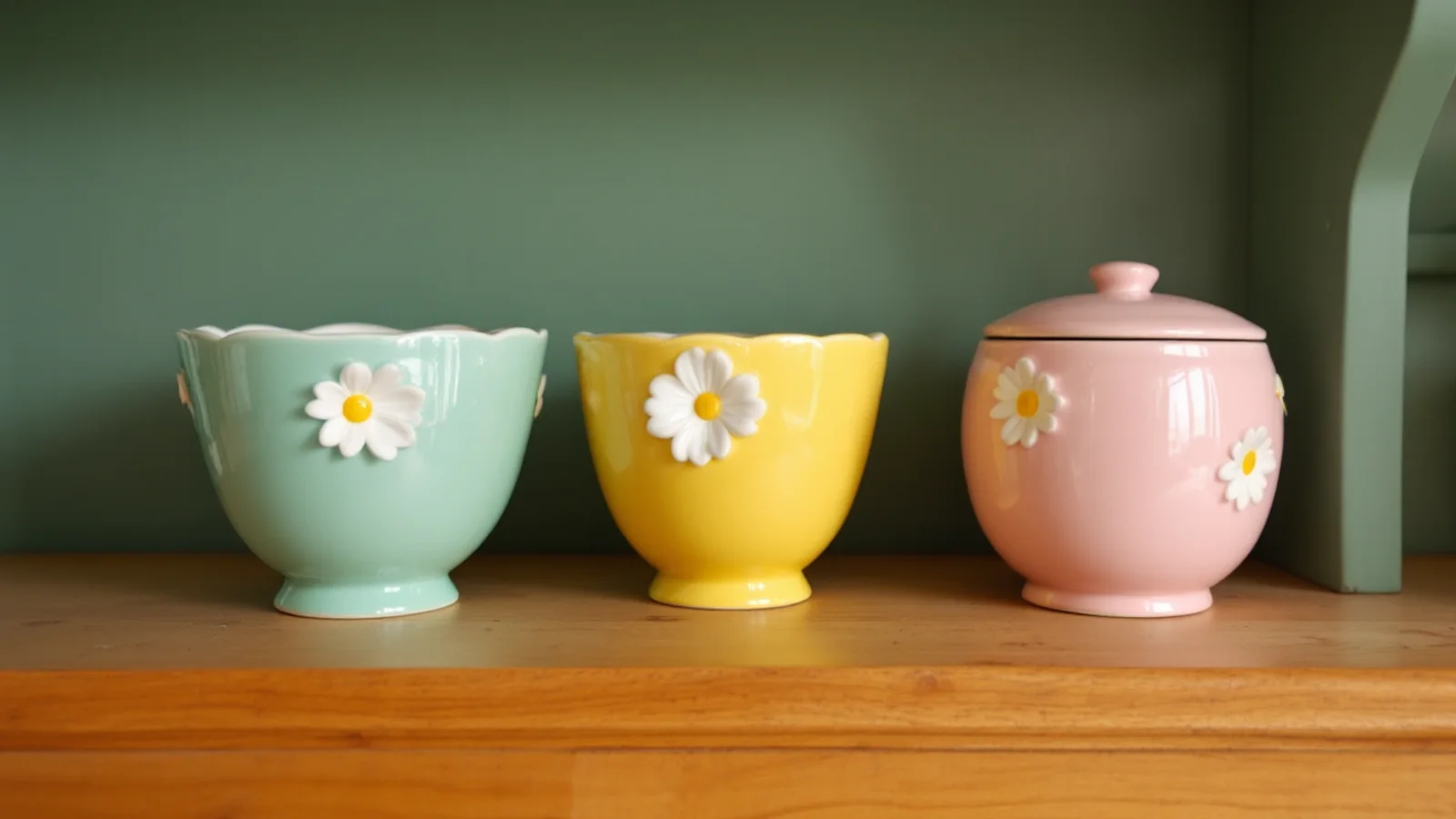
McCoy is one of the most widely collected pottery names in the United States, which means two things: plenty of buyers, and plenty of fakes. Most planters and vases sell modestly; cookie jars carry the market. Before you price anything, check the mark, because the history of the McCoy trademark after 1990 is the key to telling real from reproduction.
Which McCoy?
"McCoy pottery" covers more than one company, and collectors keep them apart. According to Wikipedia's history of the brand, the main line is the Nelson McCoy pottery in Roseville, Ohio, produced from 1910 until 1990. A related company, Brush-McCoy, came from the J.W. McCoy Pottery after George Brush acquired it in 1911; the McCoy family sold its interest in 1918 and Brush-McCoy ceased operating in 1982. When people say McCoy today, they almost always mean Nelson McCoy.
Date it by the company timeline
The Nelson McCoy story, from Wikipedia, gives you the dates you need to read a mark:
| Year | What happened | What it means for your piece |
|---|
| 1910 | Nelson McCoy Sanitary and Stoneware Company founded in Roseville, Ohio | Early utilitarian stoneware |
| 1918 to 1926 | Part of the American Clay Products Company, whose wares carried no trademark | Unmarked stoneware from this period |
| Around 1929 | The company begins marking its wares | No evidence of marked pieces before this |
| 1933 | Renamed Nelson McCoy Pottery Co.; shift to decorative pieces | The start of the planters, vases and cookie jars people collect |
| 1967 | Sold to the owners of Mt. Clemens Pottery | Later production |
| 1974 | Purchased by Lancaster Colony | Later production |
| 1985 | Sold to Designer Accents; marketed as Nelson McCoy Ceramics | Late production, some with the McCoy name |
| 1990 | Production ends | Nothing genuine is made after this |
Chairish's collector guide adds a detail on the marks themselves: early marks included "McCoy" and "Loy-Nel-Art," style numbers appeared around 1929, and the mark shifted to "McCoy" alone in the mid 1940s.
The trademark gap and the fakes
This is the part every McCoy buyer and seller should know. When the pottery closed in 1990, nobody held the McCoy trademark for pottery. Wikipedia lays out what happened next: Designer Accents had applied for it in 1989, and that application was canceled in 1997. In 1992, a man in Tennessee applied to use "McCoy" as a trademark on pottery he made, stating that he had begun using it in January 1991. That application was canceled in 1999. Another person in Florida applied in 1999 and abandoned the application in 2001.
The practical result: pottery marked "McCoy" was produced after the real factory had closed, by people who had no connection to it. Some of it copies well-known McCoy cookie jars. That is why a McCoy mark alone does not prove a piece is genuine. Signs to check:
- Size. Reproductions cast from a genuine piece shrink in the kiln, so they often come out slightly smaller than the original. Compare dimensions with documented examples.
- Mold detail. Copies made from molds taken off finished pieces lose crispness. Soft detail is a warning sign.
- The mark's form. Compare the lettering and placement with marks documented for the period of that design.
- Glaze and colors. Colors that were never offered on the original design point to a reproduction.
What sells: cookie jars first
Chairish's collector guide singles out cookie jars and novelty items as what McCoy collectors want most, along with vases and wall pockets. Cookie jars lead because they were used every day: lids broke, jars chipped, and complete examples in good condition became scarcer than the planters made alongside them. We are not quoting record prices here, because the figures that circulate for McCoy are mostly asking prices on dealer sites, not documented sales. Price from sold listings for the specific design.
The typical McCoy planter, flower pot or small vase sells for a modest amount, because the factory made them in enormous numbers for florists and variety stores over five decades. That volume is also why McCoy is so widely collected: anyone can start.
Why McCoy collecting is so broad
McCoy made pottery for ordinary households for most of the 20th century, sold through florists, variety stores and catalogs. That is why the brand turns up at nearly every estate sale in the Midwest and why so many people collect it: pieces are easy to find, affordable, and cover decades of changing styles. The flip side is that the common pieces will never be scarce. The value concentrates in designs made for shorter periods, in novelty forms like cookie jars that broke or lost their lids in use, and in pieces in unusual glazes. Collectors who know the line well spend most of their time looking for those few, and that is the mindset to bring to your own box.
Keep the box together while you sort it. Lids, bases and matching pieces get separated easily, and a cookie jar reunited with its lid is worth far more than the two parts sold apart.
How to price a McCoy piece
- Read the mark and place it in the timeline above. Unmarked pieces may still be McCoy, but they need identification by form.
- Identify the design. Planters, cookie jars and vases are cataloged by design name; search with a description of the form and compare images.
- Check for reproduction signs on anything that looks valuable, especially cookie jars.
- Check condition. Chips, cracks and repairs lower value, and cookie jars should have their original lids.
- Search sold listings for the design name, color and condition together. Asking prices on McCoy are often far above what sells.
Condition notes
| Problem | Effect |
|---|
| Chips or repairs | Reduce value, as Chairish notes; bright, intact glaze is what buyers want |
| Missing or replacement cookie jar lid | Large drop; the lid is half the object |
| Crazing | Lowers value, more on light glazes where it shows |
| Stains inside planters | Common from use; usually only a small reduction on common planters |
Lines and marks worth knowing
A few details help when sorting a box of McCoy. The Floraline line, first produced by Nelson McCoy in 1960 with its own distinctive mark, was continued under later owners, according to Wikipedia, so a Floraline mark covers a long span of production. Pieces marketed as Nelson McCoy Ceramics date from the Designer Accents years after 1985. And Brush-McCoy pieces, from the separate Brush company, are their own collecting area with their own marks; do not price them as Nelson McCoy.
Many McCoy planters and vases were sold to florists, so they often show signs of use: mineral rings, soil stains, small chips on the base. Buyers expect some of that on common planters and price it in. On a cookie jar, they do not.
Where to sell
| Option | Good for | Watch out for |
|---|
| Online marketplaces | Cookie jars and named designs with clear photos of the mark | Buyers will ask about reproduction signs; answer with photos and measurements |
| Antique malls and flea markets | Common planters and pots | Modest prices, steady demand |
| Pottery shows and collector clubs | Rare cookie jars and unusual vases | Buyers there know the reproductions well |
What to do with yours
| You have | Best move |
|---|
| Common planters and flower pots | Sell as a lot or individually for modest prices; they sell steadily. |
| Cookie jars with lids, marked | Check for reproduction signs, then price each from sold listings. |
| Unusual vases or wall pockets | Research the design individually. |
| Pieces you suspect are reproductions | Sell honestly as decorative pottery, not as McCoy. |
McCoy and Roseville were neighbors, and their pottery often turns up together; the Roseville pottery value guide covers the art pottery side. For other makers, see the pottery value guide.